The Hercules Beetle (Dynastes hercules): The Insect World's Colossal Titan


Insect Information
The Hercules Beetle (Dynastes hercules): The Insect World's Colossal Titan

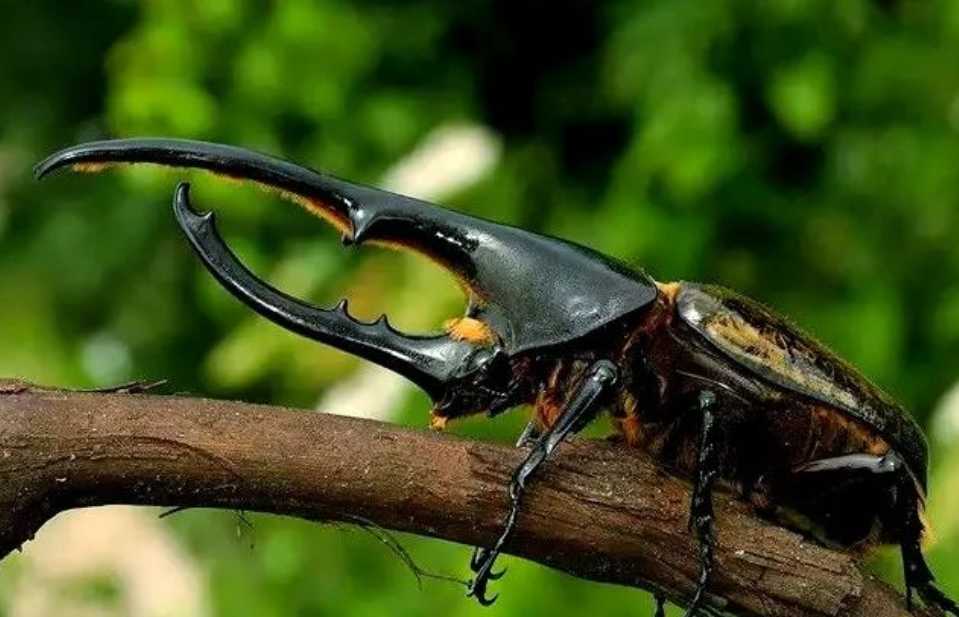
The Hercules beetle, Dynastes hercules, reigns as one of the longest beetles on Earth, captivating observers with its imposing size and extraordinary strength. Native to the rainforests of Central and South America, this scarab beetle earns its name from the mythological hero, boasting a pair of horns that define its iconic appearance and earned it the title "Hercules of the Insect World."

Morphology: A Masterpiece of Evolutionary Design

  • Size and Horn Structure: Males can reach lengths of up to 17 centimeters, with the anterior horn accounting for nearly half of their body length. This Y-shaped horn is curved and ridged, evolved for ritual combat rather than feeding. Females, while smaller and hornless, have robust mandibles for excavating oviposition sites in decaying wood.
  • Coloration: Their exoskeletons range from glossy black to deep green or brown, often with subtle iridescence. This pigmentation helps them blend into the rainforest floor, while the horns serve as both a display feature and a weapon.
  • Astonishing Strength: Perhaps their most remarkable trait is their lifting capacity: they can carry objects up to 850 times their own body weight. To contextualize this, it’s the equivalent of a human lifting a truck—a feat enabled by specialized thoracic muscles and a sturdy exoskeletal structure.

Ecological Role and Behavior in the Wild

  • Habitat and Diet: Found in tropical rainforests from Mexico to Brazil, Hercules beetles thrive in humid, forested environments. Larvae feed on decaying wood and plant matter, acting as natural decomposers that enhance nutrient cycling. Adults primarily consume tree sap, fruit juices, and nectar.
  • Mating Rituals: Male beetles use their horns in dramatic battles over females, locking horns and attempting to lift or toss rivals. These contests are rarely fatal but determine mating access, showcasing the evolutionary trade-off between size and agility.
  • Life Cycle: Larvae spend 1–2 years in the soil, growing within rotting logs before pupating. Adults emerge for a brief life (2–3 months) focused solely on reproduction, embodying the rainforest’s strategy of rapid growth and reproduction.

Cultural Significance and Conservation

  • Symbol of Strength: In many indigenous cultures, the beetle’s might is revered, often appearing in folklore as a symbol of perseverance and power. In the pet trade, they are popular among insect enthusiasts for their striking appearance, though captive breeding has reduced pressure on wild populations.
  • Threats and Protection: Deforestation and habitat loss pose risks to their survival, as they depend on mature forests for larval development. While not yet endangered, conservation efforts focus on preserving rainforest ecosystems and promoting sustainable logging practices.

Biomimicry and Scientific Wonder

The beetle’s exceptional strength and horn structure have inspired engineers and material scientists. Studies of their exoskeletal mechanics inform the design of lightweight, load-bearing structures in robotics and architecture. Additionally, their ability to thrive in nutrient-poor environments offers insights into sustainable decomposition processes, contributing to efforts in waste management and ecological restoration.


From its mythical namesake to its role as a rainforest keystone species, the Hercules beetle exemplifies nature’s ability to evolve both grandeur and functionality. As one of the insect world’s most iconic giants, it serves as a living testament to the wonders of adaptation—and a reminder of the fragile balance between human fascination and ecological preservation.
Latest Stories
Feline News2 minute readThe Korat cat, originating from Thailand’s Nakhon Ratchasima province (formerly Korat), is a breed deeply rooted in history and cultural significance. Revered for centuries as a symbol of good luck and prosperity, these silver-blue felines have enchanted the world with their striking appearance and affectionate nature.
Feline News2 minute readThe Burmese cat, a breed steeped in history and adored for its regal charm, continues to captivate cat lovers worldwide. Originating from Myanmar (formerly Burma), these medium-sized shorthairs are celebrated for their luxurious coat, affectionate demeanor, and intelligence. Here’s an in-depth look at this ancient breed, combining the latest research and international standards
Feline News2 minute readThe Russian Blue, with its silvery-blue coat and piercing emerald eyes, stands as a paragon of feline elegance, earning the title "Noble of the Shorthairs" 5. Originating from Arkhangelsk Port in Russia—once known as the "Blue Angel Harbor"—this ancient breed derived its name not from color but from its birthplace 3. In 1860, sailors introduced them to Europe, and they debuted at London's Crystal Palace Exposition in 1875 as "Archangel Cats," captivating audiences with their otherworldly allure
Astro Information1 minute readEnceladus, Saturn’s icy moon, harbors a subsurface ocean beneath tiger-stripe fractures that erupt icy particles into space. These geysers form a dense ice cloud over the south pole, feeding Saturn’s faint E ring. The Cassini spacecraft (2004–2017) provided definitive evidence, capturing this true-color, high-resolution image during a close flyby, revealing shadowed ice chasms and active vents.
Animal Information1 minute readNative to Africa, warthogs (Phacochoerus) earn their name from the fleshy facial warts beneath their eyes. Split into the common warthog and desert warthog, these ungulates have heads comprising one-third of their body length, with tusks reaching 64 cm. They subsist on grass roots and tubers, surviving months without water—adaptations that define their harsh savanna lifestyle.
Astro Information2 minute readA close-up from NASA’s Mars Reconnaissance Orbiter (MRO) HiRISE camera unveils the weathered craters and aeolian features of southern Acidalia Planitia. While standard HiRISE imagery often appears in striking blue tones—a result of multispectral processing to enhance geological details—the region would likely appear gray or pale red to human eyes. Of course, no human has yet witnessed this Martian landscape firsthand—unless we count Andy Weir’s fictional NASA astronaut in The Martian.
Feline News1 minute readDubbed the "parlor panther," the Bombay Cat captivates with its jet-black coat and mesmerizing copper-gold eyes, an uncanny resemblance to the wild black leopard. Originating in 1958, Kentucky breeder Nikki Horner meticulously crossed sable Burmese cats with black American Shorthairs, aiming to create a domestic feline embodying both exotic allure and gentle temperament. After years of selective breeding, her vision became reality, establishing the Bombay as a breed that bridges wild aesthetics with affectionate companionship.