Saturn’s Enceladus: Does an Ocean beneath Ice Harbor Life?


Astro Information
Saturn’s Enceladus: Does an Ocean beneath Ice Harbor Life?

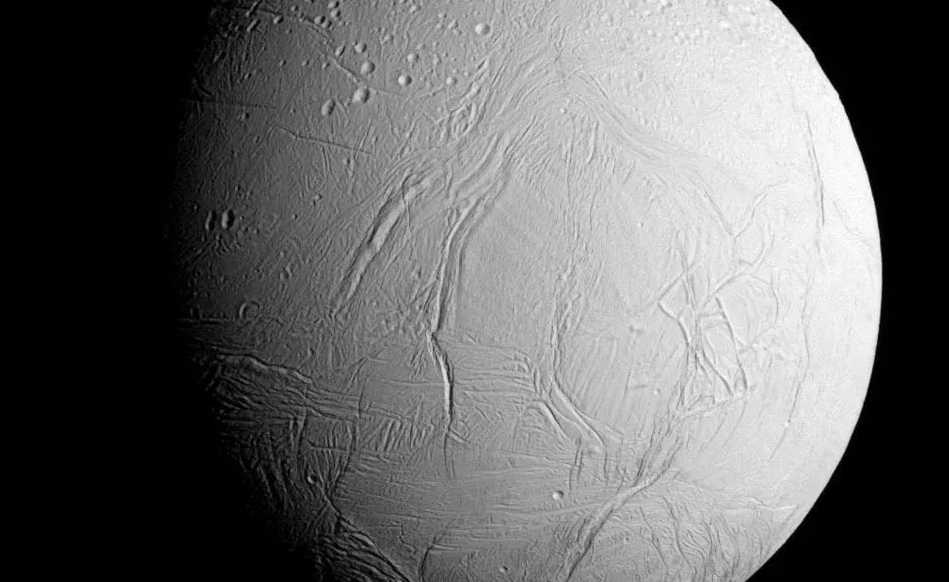
Enceladus, Saturn’s icy moon, harbors a subsurface ocean beneath tiger-stripe fractures that erupt icy particles into space. These geysers form a dense ice cloud over the south pole, feeding Saturn’s faint E ring. The Cassini spacecraft (2004–2017) provided definitive evidence, capturing this true-color, high-resolution image during a close flyby, revealing shadowed ice chasms and active vents.

Geological Mystery: Why Enceladus Thrives While Mimas Slumbers

Enceladus’ "Tiger Stripes"—four parallel fractures each 130 km long—pulse with eruptions, flinging water vapor and ice grains at 800 km/h. Unusually, this activity persists despite Enceladus’ tiny size (504 km diameter). By contrast, similar-sized Mimas lies geologically dead. Scientists suspect tidal heating from Saturn’s gravity flexes Enceladus’ core, generating the warmth needed to sustain its subsurface ocean.


Cassini’s radar revealed a 10–30 km deep ocean beneath a 30–40 km ice crust. The moon’s south pole shows recent surface resurfacing, indicating ongoing activity—unlike most icy moons, which are geologically frozen.

Organic Molecules in Eruptions: Clues to Possible Life

Analysis of Enceladus’ plume particles revealed complex organic molecules, including benzene and long-chain hydrocarbons. These carbon-rich compounds, detected in 2015 by Cassini’s mass spectrometer, are building blocks of life as we know it. While not proof of life, their presence suggests the ocean may have a habitable chemistry:


  • Warm Hydrothermal Vents: Subsurface ocean models predict hydrothermal activity at Enceladus’ seafloor, similar to Earth’s deep-sea vents where life thrives.
  • Energy Sources: Dissolved salts and chemical gradients in the ocean could provide energy for microbial life.


"Enceladus is a top target for astrobiology," says Dr. Linda Spilker, Cassini project scientist. "Its ocean has liquid water, organic materials, and energy sources—three key ingredients for life."


Future missions like NASA’s Enceladus Orbilander (proposed) aim to sample the plume directly, searching for biosignatures. Until then, Enceladus remains a cosmic enigma—an icy moon spraying hints of life into the Saturnian system.

Latest Stories
Animal Information1 minute readScientifically known as Psychrolutes marcidus, the blobfish inhabits 600–1,200m deep-sea waters, measuring 30–38 cm in length. This gelatinous creature lacks bones and muscles, with a body density slightly lower than water—enabling it to float passively while capturing prey.
Bird Information1 minute readWith wingspans exceeding 3 meters, albatrosses reign as the Southern Ocean’s ultimate flight virtuosos, capable of continuous flights lasting weeks without touching land. Their lives are a testament to maritime endurance—spending most existence adrift over waves, they’ve even mastered the art of sleeping mid-flight.
Car Information1 minute readGatebil has solidified its status as a cornerstone of Scandinavian automotive subculture, though its exact founding date remains unchronicled. Documentation suggests organized events emerged around 2005, birthed from a grassroots movement of motorsport enthusiasts seeking a platform to showcase modified vehicles, share automotive passion, and celebrate driving joy.
Car Information1 minute readAs the E90 3 Series debuted, the E46 M3 CS emerged as the final hurrah for BMW’s iconic sports sedan. Priced at £2,400 for the Competition Package (CS Kit) in the UK, the total cost of an M3 equipped with these upgrades reached £43,555—modest upgrades on paper
Astro Information1 minute readNGC 6302, a planetary nebula nicknamed the "Butterfly Nebula," lives up to its floral-insect moniker with wing-like gas plumes spanning 3 light-years. Located 4,000 light-years away in Scorpius, this stellar corpse showcases the dramatic final act of a massive star—now a 250,000°C central star evolving into a white dwarf, its ultraviolet radiation ionizing the surrounding nebula into a kaleidoscopic display.
Car Information1 minute readAt first glance, this 2004 Lamborghini Murciélago for sale in the US appears like any other iconic V12 supercar from the Italian marque—until you catch a glimpse of its rear end. The exhaust design, far from conventional, forms a quirky silhouette that uncannily resembles a frog, complete with rounded "eyes" and a wide, downturned "mouth" framing the tailpipes.
Feline News2 minute readThe Oriental Shorthair, a breed celebrated for its striking elegance and dynamic personality, traces its origins to mid-20th century breeding programs in the UK and the US2. Developed as a close relative of the Siamese, these cats emerged from intentional crossbreeding with British Shorthairs and Abyssinians to create a feline with the Siamese’s sleek physique but expanded coat color possibilities28. By the 1970s, the breed gained international recognition, captivating cat lovers worldwide with its unique charm.