HiRISE Reveals Mars' Acidalia Planitia: Where Sci-Fi Meets Scientific Reality


Astro Information
HiRISE Reveals Mars' Acidalia Planitia: Where Sci-Fi Meets Scientific Reality

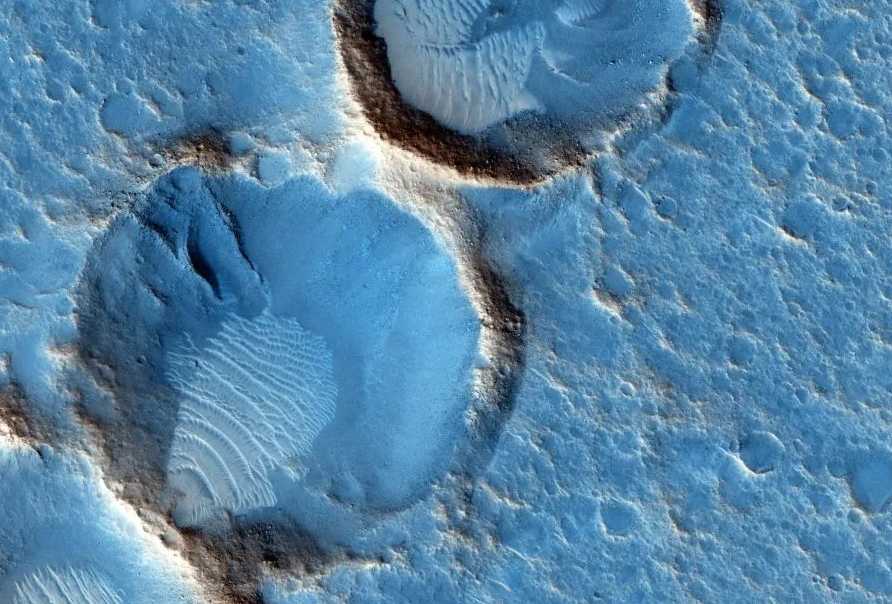
A close-up from NASA’s Mars Reconnaissance Orbiter (MRO) HiRISE camera unveils the weathered craters and aeolian features of southern Acidalia Planitia. While standard HiRISE imagery often appears in striking blue tones—a result of multispectral processing to enhance geological details—the region would likely appear gray or pale red to human eyes. Of course, no human has yet witnessed this Martian landscape firsthand—unless we count Andy Weir’s fictional NASA astronaut in The Martian.

Sci-Fi Ground Zero: Ares 3’s Fictional Landing Site

Weir’s novel places astronaut Mark Watney’s stranded mission at "Ares 3," whose fictional coordinates align with the cropped HiRISE scene. Watney’s 6-meter-diameter habitat module would measure just one-tenth the width of the largest crater in this image—a humbling scale comparison. Intriguingly, the imagined Ares 3 site lies ~800 km from the real-world Carl Sagan Memorial Station, where NASA’s 1997 Pathfinder lander touched down, bridging fiction and scientific history.

Geological Tales in the Martian Dust

The landscape tells a story of cosmic collisions and wind-driven erosion:


  • Impact Craters: Ranging from fresh, sharp-rimmed craters to ancient, degraded basins, these scars record billions of years of asteroid strikes.
  • Dune Fields: Sinuous dark ridges are barchan dunes, shaped by prevailing winds that sweep iron-rich dust across the plains.
  • Layered Deposits: Subtle color variations hint at sedimentary layers, possibly formed by ancient water or volcanic activity.


HiRISE’s 0.3-meter/pixel resolution reveals features as small as a picnic table, allowing scientists to study Martian geology in unprecedented detail.

When Fiction Inspires Reality (and Vice Versa)

The Pathfinder mission, which deployed the rover Sojourner, predated The Martian by two decades but shares thematic ties: both explore human resilience on Mars. Watney’s reliance on botanical ingenuity mirrors real-life plans for Martian agriculture, while the Ares 3 site’s proximity to actual landing zones highlights the scientific plausibility Weir infused into his story.


"Astronauts may one day walk where Watney ‘survived,’" says Dr. Alfred McEwen, HiRISE principal investigator. "HiRISE data helps mission planners identify safe landing zones and resources like subsurface ice—just as The Martian imagined."

The Color Conundrum: Why Mars Isn’t as Red as We Think

HiRISE’s blue-tinted images serve a scientific purpose, not artistic license:


  • False Color Processing: Infrared and visible light bands are combined to distinguish minerals—blue might represent basaltic rocks, while red signals iron oxides.
  • True Color vs. Perception: Mars’ iconic red hue comes from iron oxide (rust) in surface dust, but large-scale landscapes often appear tan or gray under the planet’s thin, dusty atmosphere.


As humanity prepares for crewed Mars missions, images like this bridge the gap between scientific data and popular imagination—reminding us that the line between a fictional astronaut’s survival story and real-life exploration is as thin as Mars’ atmosphere, yet as profound as the Red Planet itself.

Latest Stories
Feline News2 minute readThe Korat cat, originating from Thailand’s Nakhon Ratchasima province (formerly Korat), is a breed deeply rooted in history and cultural significance. Revered for centuries as a symbol of good luck and prosperity, these silver-blue felines have enchanted the world with their striking appearance and affectionate nature.
Feline News2 minute readThe Burmese cat, a breed steeped in history and adored for its regal charm, continues to captivate cat lovers worldwide. Originating from Myanmar (formerly Burma), these medium-sized shorthairs are celebrated for their luxurious coat, affectionate demeanor, and intelligence. Here’s an in-depth look at this ancient breed, combining the latest research and international standards
Feline News2 minute readThe Russian Blue, with its silvery-blue coat and piercing emerald eyes, stands as a paragon of feline elegance, earning the title "Noble of the Shorthairs" 5. Originating from Arkhangelsk Port in Russia—once known as the "Blue Angel Harbor"—this ancient breed derived its name not from color but from its birthplace 3. In 1860, sailors introduced them to Europe, and they debuted at London's Crystal Palace Exposition in 1875 as "Archangel Cats," captivating audiences with their otherworldly allure
Astro Information1 minute readEnceladus, Saturn’s icy moon, harbors a subsurface ocean beneath tiger-stripe fractures that erupt icy particles into space. These geysers form a dense ice cloud over the south pole, feeding Saturn’s faint E ring. The Cassini spacecraft (2004–2017) provided definitive evidence, capturing this true-color, high-resolution image during a close flyby, revealing shadowed ice chasms and active vents.
Animal Information1 minute readNative to Africa, warthogs (Phacochoerus) earn their name from the fleshy facial warts beneath their eyes. Split into the common warthog and desert warthog, these ungulates have heads comprising one-third of their body length, with tusks reaching 64 cm. They subsist on grass roots and tubers, surviving months without water—adaptations that define their harsh savanna lifestyle.
Astro Information2 minute readA close-up from NASA’s Mars Reconnaissance Orbiter (MRO) HiRISE camera unveils the weathered craters and aeolian features of southern Acidalia Planitia. While standard HiRISE imagery often appears in striking blue tones—a result of multispectral processing to enhance geological details—the region would likely appear gray or pale red to human eyes. Of course, no human has yet witnessed this Martian landscape firsthand—unless we count Andy Weir’s fictional NASA astronaut in The Martian.
Feline News1 minute readDubbed the "parlor panther," the Bombay Cat captivates with its jet-black coat and mesmerizing copper-gold eyes, an uncanny resemblance to the wild black leopard. Originating in 1958, Kentucky breeder Nikki Horner meticulously crossed sable Burmese cats with black American Shorthairs, aiming to create a domestic feline embodying both exotic allure and gentle temperament. After years of selective breeding, her vision became reality, establishing the Bombay as a breed that bridges wild aesthetics with affectionate companionship.