The Happy Face Spider: Hawaii’s Cryptic Arthropod with a Smiling Survival Strategy


Animal Information
The Happy Face Spider: Hawaii’s Cryptic Arthropod with a Smiling Survival Strategy

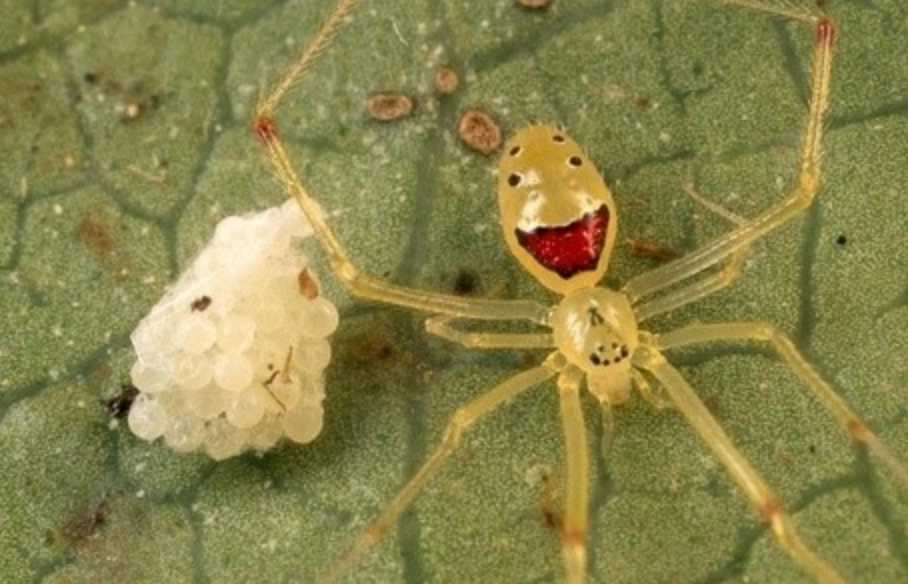
Endemic to the rainforests of Hawaii, the happy face spider (Theridion grallator) is a tiny arachnid celebrated for its most whimsical trait—a ventral abdomen marked with patterns resembling a smiling face. Discovered in the 19th century, this cryptic spider has captivated entomologists with its unique coloration and the evolutionary mystery behind its cheerful design.

A Smiley Mark in the Canopy: Physical Traits

  • Miniature Marvel with Variable Patterns
    Females measure just 5–8 mm, while males are slightly smaller, with long, spindly legs adapted for web-building in fern fronds and leaf litter. The abdomen’s "smile" consists of yellow or orange markings bordered by black lines, forming eye-like spots and a curved mouth. Patterns vary widely—some resemble bold smiles, others faint frowns or abstract designs—though the exact cause of this variation remains unclear.
  • Camouflage and Warning Coloration
    The spider’s dorsal side is typically pale green or brown, blending with foliage, while the bright ventral patterns may serve as aposematic (warning) coloration to deter predators. However, the "smile" also confuses birds or lizards, directing attacks to the non-vital abdomen rather than the head.

Life Cycle and Island Adaptations

  • Webbing and Prey
    Happy face spiders build tangled orb webs in the understory, trapping small insects like gnats and flies. They hang upside-down in their webs, displaying the abdominal pattern to potential threats. Females lay eggs in silk sacs, guarding them until hatchlings disperse via "ballooning"—releasing silk threads to catch the wind.
  • Hawaiian Endemism
    Found only on the islands of Oahu, Maui, Molokai, and Hawaii, this spider is a product of Hawaii’s isolated evolution. Its closest relatives are found in Australia, suggesting a distant ancestral migration. The species thrives in moist, native forests, relying on specific plant hosts for web attachment.

Conservation and Cultural Significance

  • Threats to a Cheerful Existence
    Listed as "Vulnerable" due to habitat loss from deforestation and invasive species (e.g., ants and spiders that compete for resources), the happy face spider faces risks from climate change and tourism. Its dependence on native Hawaiian plants makes it especially susceptible to ecosystem degradation.
  • Symbol of Aloha and Scientific Wonder
    In Hawaiian culture, the spider’s smile is seen as a symbol of joy and resilience, while scientists study its color genetics to understand how patterns evolve in isolated populations. Its discovery has also highlighted the importance of protecting Hawaii’s unique invertebrate fauna, many of which exist nowhere else on Earth.


With its tiny, grinning abdomen, the happy face spider serves as a reminder of nature’s playful side—an evolutionary joke written in pigment on the body of a creature barely visible to the naked eye. In the lush rainforests of Hawaii, this little arachnid proves that even in the most competitive ecosystems, a touch of whimsy can be the key to survival.

Latest Stories
Feline News2 minute readThe Korat cat, originating from Thailand’s Nakhon Ratchasima province (formerly Korat), is a breed deeply rooted in history and cultural significance. Revered for centuries as a symbol of good luck and prosperity, these silver-blue felines have enchanted the world with their striking appearance and affectionate nature.
Feline News2 minute readThe Burmese cat, a breed steeped in history and adored for its regal charm, continues to captivate cat lovers worldwide. Originating from Myanmar (formerly Burma), these medium-sized shorthairs are celebrated for their luxurious coat, affectionate demeanor, and intelligence. Here’s an in-depth look at this ancient breed, combining the latest research and international standards
Feline News2 minute readThe Russian Blue, with its silvery-blue coat and piercing emerald eyes, stands as a paragon of feline elegance, earning the title "Noble of the Shorthairs" 5. Originating from Arkhangelsk Port in Russia—once known as the "Blue Angel Harbor"—this ancient breed derived its name not from color but from its birthplace 3. In 1860, sailors introduced them to Europe, and they debuted at London's Crystal Palace Exposition in 1875 as "Archangel Cats," captivating audiences with their otherworldly allure
Astro Information1 minute readEnceladus, Saturn’s icy moon, harbors a subsurface ocean beneath tiger-stripe fractures that erupt icy particles into space. These geysers form a dense ice cloud over the south pole, feeding Saturn’s faint E ring. The Cassini spacecraft (2004–2017) provided definitive evidence, capturing this true-color, high-resolution image during a close flyby, revealing shadowed ice chasms and active vents.
Animal Information1 minute readNative to Africa, warthogs (Phacochoerus) earn their name from the fleshy facial warts beneath their eyes. Split into the common warthog and desert warthog, these ungulates have heads comprising one-third of their body length, with tusks reaching 64 cm. They subsist on grass roots and tubers, surviving months without water—adaptations that define their harsh savanna lifestyle.
Astro Information2 minute readA close-up from NASA’s Mars Reconnaissance Orbiter (MRO) HiRISE camera unveils the weathered craters and aeolian features of southern Acidalia Planitia. While standard HiRISE imagery often appears in striking blue tones—a result of multispectral processing to enhance geological details—the region would likely appear gray or pale red to human eyes. Of course, no human has yet witnessed this Martian landscape firsthand—unless we count Andy Weir’s fictional NASA astronaut in The Martian.
Feline News1 minute readDubbed the "parlor panther," the Bombay Cat captivates with its jet-black coat and mesmerizing copper-gold eyes, an uncanny resemblance to the wild black leopard. Originating in 1958, Kentucky breeder Nikki Horner meticulously crossed sable Burmese cats with black American Shorthairs, aiming to create a domestic feline embodying both exotic allure and gentle temperament. After years of selective breeding, her vision became reality, establishing the Bombay as a breed that bridges wild aesthetics with affectionate companionship.