The Graceful Mourning Dove: A Common Sight in the Americas


Bird Information
The Graceful Mourning Dove: A Common Sight in the Americas

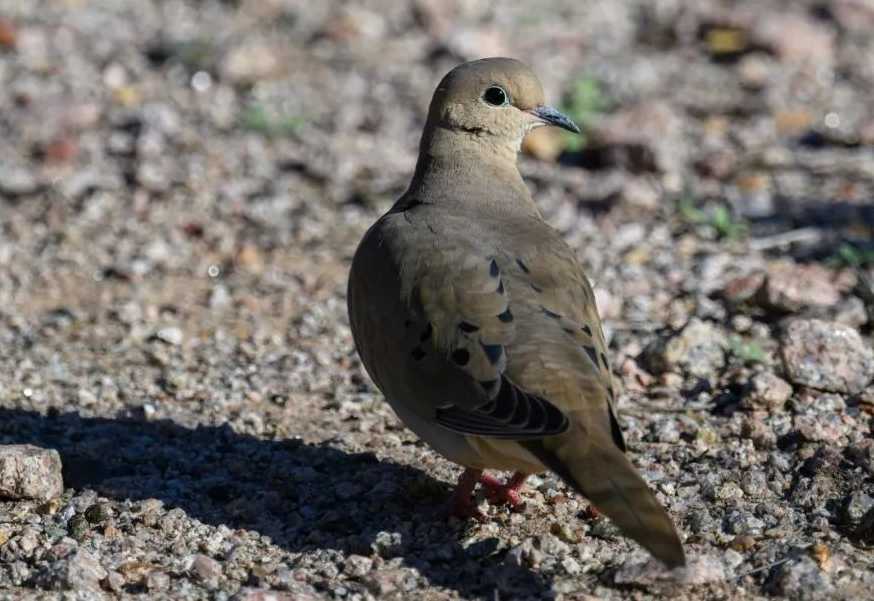
The Mourning Dove (Zenaida macroura) is a captivating bird that has charmed observers across the Americas. With its gentle demeanor and distinct appearance, it has become a familiar presence in various landscapes.


Measuring around 31 centimeters in length and weighing between 112 - 170 grams, the Mourning Dove is a medium - sized, slender bird. Its plumage is predominantly light gray - brown, with a lighter, pinkish hue on the underparts. The wings are adorned with black spots, and the long, tapered tail features white outer feathers that contrast sharply with the black inner ones. A dark, crescent - shaped patch beneath the eye adds to its unique look. Males and females are similar in appearance, making it a bit challenging to distinguish between the two at a glance.


Native to the Americas, these doves have a wide - ranging habitat. They can be found in open woodlands, agricultural fields, suburban backyards, and even city parks. They are particularly fond of areas with scattered trees for perching and open ground for foraging. Mourning Doves are primarily seed - eaters, consuming a variety of seeds from grasses, weeds, and grains. Their diet also includes small amounts of insects, especially during the breeding season when they need the extra protein. They forage on the ground, using their sharp eyesight to spot seeds and pecking at them with their short, dark beaks.


During the breeding season, Mourning Doves engage in elaborate courtship displays. Males will puff out their chests, spread their tails, and coo softly to attract females. Once a pair has formed, they build a flimsy nest made of twigs and grasses, usually in the fork of a tree or on a horizontal branch. Females lay two small, white eggs, which both parents take turns incubating for about 14 days. After hatching, the parents feed the chicks a special substance called crop milk, a nutritious secretion from their throats. As the chicks grow, they gradually transition to a diet of seeds.


Despite being a popular game bird, with millions hunted each year in the United States, the Mourning Dove's population remains stable. This is due in part to their high reproductive rate; in warm regions, a single pair can raise up to six broods in a year. Their adaptability to human - altered landscapes has also contributed to their success. Whether seen perched on a telephone wire or flying gracefully through the sky, the Mourning Dove continues to enchant and play an important role in the ecosystems of the Americas.
Latest Stories
Feline News2 minute readThe Korat cat, originating from Thailand’s Nakhon Ratchasima province (formerly Korat), is a breed deeply rooted in history and cultural significance. Revered for centuries as a symbol of good luck and prosperity, these silver-blue felines have enchanted the world with their striking appearance and affectionate nature.
Feline News2 minute readThe Burmese cat, a breed steeped in history and adored for its regal charm, continues to captivate cat lovers worldwide. Originating from Myanmar (formerly Burma), these medium-sized shorthairs are celebrated for their luxurious coat, affectionate demeanor, and intelligence. Here’s an in-depth look at this ancient breed, combining the latest research and international standards
Feline News2 minute readThe Russian Blue, with its silvery-blue coat and piercing emerald eyes, stands as a paragon of feline elegance, earning the title "Noble of the Shorthairs" 5. Originating from Arkhangelsk Port in Russia—once known as the "Blue Angel Harbor"—this ancient breed derived its name not from color but from its birthplace 3. In 1860, sailors introduced them to Europe, and they debuted at London's Crystal Palace Exposition in 1875 as "Archangel Cats," captivating audiences with their otherworldly allure
Astro Information1 minute readEnceladus, Saturn’s icy moon, harbors a subsurface ocean beneath tiger-stripe fractures that erupt icy particles into space. These geysers form a dense ice cloud over the south pole, feeding Saturn’s faint E ring. The Cassini spacecraft (2004–2017) provided definitive evidence, capturing this true-color, high-resolution image during a close flyby, revealing shadowed ice chasms and active vents.
Animal Information1 minute readNative to Africa, warthogs (Phacochoerus) earn their name from the fleshy facial warts beneath their eyes. Split into the common warthog and desert warthog, these ungulates have heads comprising one-third of their body length, with tusks reaching 64 cm. They subsist on grass roots and tubers, surviving months without water—adaptations that define their harsh savanna lifestyle.
Astro Information2 minute readA close-up from NASA’s Mars Reconnaissance Orbiter (MRO) HiRISE camera unveils the weathered craters and aeolian features of southern Acidalia Planitia. While standard HiRISE imagery often appears in striking blue tones—a result of multispectral processing to enhance geological details—the region would likely appear gray or pale red to human eyes. Of course, no human has yet witnessed this Martian landscape firsthand—unless we count Andy Weir’s fictional NASA astronaut in The Martian.
Feline News1 minute readDubbed the "parlor panther," the Bombay Cat captivates with its jet-black coat and mesmerizing copper-gold eyes, an uncanny resemblance to the wild black leopard. Originating in 1958, Kentucky breeder Nikki Horner meticulously crossed sable Burmese cats with black American Shorthairs, aiming to create a domestic feline embodying both exotic allure and gentle temperament. After years of selective breeding, her vision became reality, establishing the Bombay as a breed that bridges wild aesthetics with affectionate companionship.