The Golden Tortoise Beetle: Shimmering Jewel of the Leaf Beetle Family with a Vast American Range


Insect Information
The Golden Tortoise Beetle: Shimmering Jewel of the Leaf Beetle Family with a Vast American Range

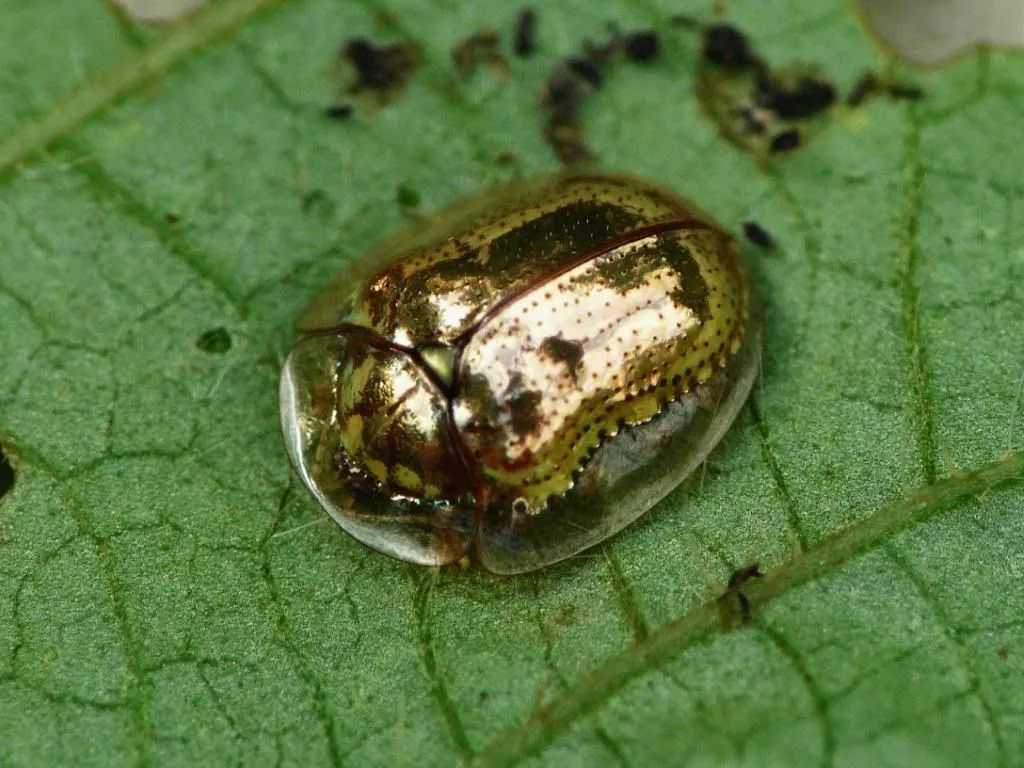
Belonging to the leaf beetle family (Chrysomelidae), the golden tortoise beetle (Charidotella sexpunctata) is a tiny arthropod renowned for its iridescent golden hue and domed, tortoise-like shell. Native to the Americas, this species boasts a remarkably wide distribution, thriving from southern Canada to South America in diverse habitats ranging from farmlands to forests.

A Living Gem: Anatomy and Adaptive Brilliance

  • Metallic Magic: The Science of Iridescence
    The beetle’s elytra (hard wing covers) display a stunning golden sheen, produced by microscopic ridges that refract light. When threatened or stressed, it can alter the moisture between these layers, temporarily turning its shell reddish-brown—a defense mechanism that startles predators. This optical trickery makes it one of nature’s most dynamic color changers among beetles.
  • Tortoise-like Design for Survival
    Growing to just 5–8 mm, its rounded, domed shape resembles a miniature tortoise, providing protection against predators. The edges of its elytra are transparent, creating a "glass-like" border that further confuses attackers. Its legs and body are pale yellow, blending seamlessly with the undersides of leaves where it feeds.

Life Cycle and Ecological Role

  • Feeding Habits and Reproduction
    The golden tortoise beetle primarily feeds on morning glory plants (Convolvulaceae), using its mandibles to scrape leaf tissue. Larvae are less glamorous—spherical and covered in spines, they carry fecal matter on their backs as a deterrent. Adults mate prolifically, laying eggs on host plants, and can undergo multiple generations per year in warm climates.
  • Invasive Potential and Natural Distribution
    While native to the Americas, its adaptability has raised concerns about potential invasions in other continents. In its natural range, it serves as prey for birds, spiders, and parasitic wasps, while also acting as a pollinator and decomposer in plant ecosystems.

Scientific Interest and Cultural Noteworthiness

Researchers study its iridescent properties to develop new materials, from optical coatings to renewable energy technologies. In popular culture, the beetle’s dazzling appearance has made it a subject of nature documentaries and educational campaigns, often celebrated as a living example of evolutionary beauty.


Despite its widespread presence, the golden tortoise beetle faces minor threats from pesticide use and habitat loss. Its resilience and adaptability, however, highlight the tenacity of small creatures in navigating human-altered landscapes—reminding us that even the tiniest jewels of nature hold secrets worth preserving
Latest Stories
Feline News2 minute readThe Korat cat, originating from Thailand’s Nakhon Ratchasima province (formerly Korat), is a breed deeply rooted in history and cultural significance. Revered for centuries as a symbol of good luck and prosperity, these silver-blue felines have enchanted the world with their striking appearance and affectionate nature.
Feline News2 minute readThe Burmese cat, a breed steeped in history and adored for its regal charm, continues to captivate cat lovers worldwide. Originating from Myanmar (formerly Burma), these medium-sized shorthairs are celebrated for their luxurious coat, affectionate demeanor, and intelligence. Here’s an in-depth look at this ancient breed, combining the latest research and international standards
Feline News2 minute readThe Russian Blue, with its silvery-blue coat and piercing emerald eyes, stands as a paragon of feline elegance, earning the title "Noble of the Shorthairs" 5. Originating from Arkhangelsk Port in Russia—once known as the "Blue Angel Harbor"—this ancient breed derived its name not from color but from its birthplace 3. In 1860, sailors introduced them to Europe, and they debuted at London's Crystal Palace Exposition in 1875 as "Archangel Cats," captivating audiences with their otherworldly allure
Astro Information1 minute readEnceladus, Saturn’s icy moon, harbors a subsurface ocean beneath tiger-stripe fractures that erupt icy particles into space. These geysers form a dense ice cloud over the south pole, feeding Saturn’s faint E ring. The Cassini spacecraft (2004–2017) provided definitive evidence, capturing this true-color, high-resolution image during a close flyby, revealing shadowed ice chasms and active vents.
Animal Information1 minute readNative to Africa, warthogs (Phacochoerus) earn their name from the fleshy facial warts beneath their eyes. Split into the common warthog and desert warthog, these ungulates have heads comprising one-third of their body length, with tusks reaching 64 cm. They subsist on grass roots and tubers, surviving months without water—adaptations that define their harsh savanna lifestyle.
Astro Information2 minute readA close-up from NASA’s Mars Reconnaissance Orbiter (MRO) HiRISE camera unveils the weathered craters and aeolian features of southern Acidalia Planitia. While standard HiRISE imagery often appears in striking blue tones—a result of multispectral processing to enhance geological details—the region would likely appear gray or pale red to human eyes. Of course, no human has yet witnessed this Martian landscape firsthand—unless we count Andy Weir’s fictional NASA astronaut in The Martian.
Feline News1 minute readDubbed the "parlor panther," the Bombay Cat captivates with its jet-black coat and mesmerizing copper-gold eyes, an uncanny resemblance to the wild black leopard. Originating in 1958, Kentucky breeder Nikki Horner meticulously crossed sable Burmese cats with black American Shorthairs, aiming to create a domestic feline embodying both exotic allure and gentle temperament. After years of selective breeding, her vision became reality, establishing the Bombay as a breed that bridges wild aesthetics with affectionate companionship.