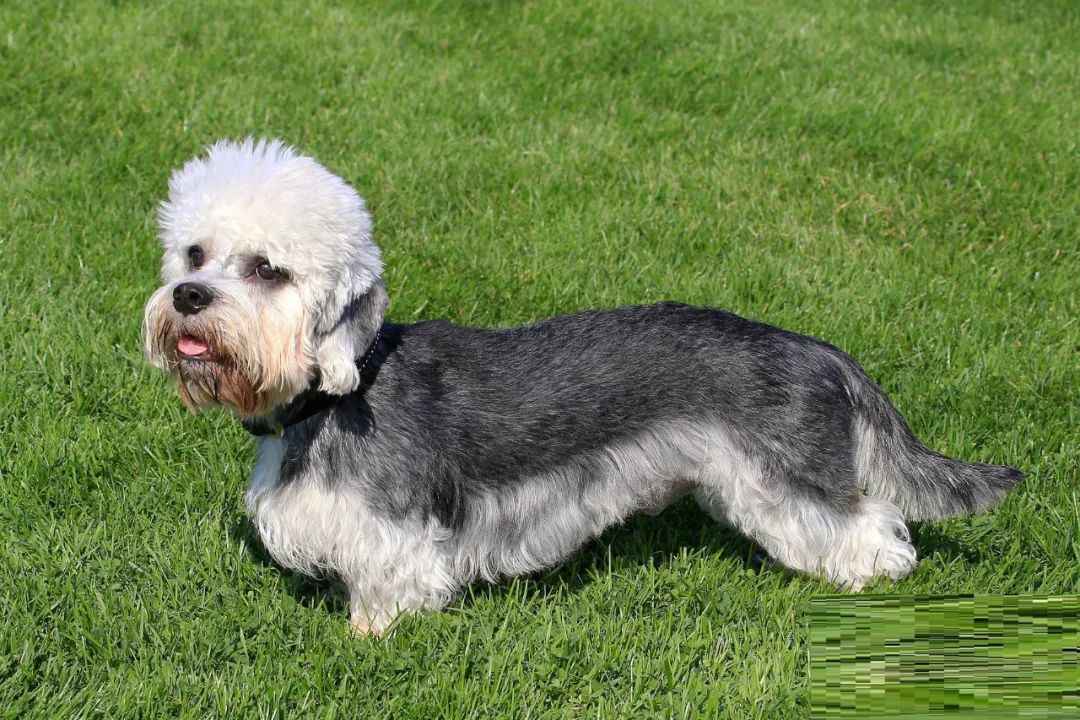
Dandie Dinmont Terrier: A Quirky Breed with a Rich History


Canine News
Dandie Dinmont Terrier: A Quirky Breed with a Rich History

The Dandie Dinmont Terrier, a distinctive breed hailing from the Scottish-English border, has captivated dog enthusiasts for centuries with its unique appearance and spirited personality. Named after a character in Sir Walter Scott’s novel Guy Mannering, this short-legged, long-bodied terrier was originally bred in the 17th century for hunting badgers and otters 16. Its compact size (8–11 inches tall) and muscular build made it a tenacious worker, capable of navigating rugged terrains while tracking prey.


Distinctive Features

The breed’s most striking trait is its shaggy, dual-layered coat, which comes in two classic colorations: “pepper” (dark gray to silver) and “mustard” (light yellow to reddish-brown) 78. A prominent “topknot” of soft hair adorns its head, contrasting with the harsh outer coat. Large, expressive eyes and drooping ears add to its endearing appearance, earning it accolades like “Most Beautiful Eyes” at dog shows 36.

Temperament and Behavior

Despite its small stature, the Dandie Dinmont Terrier is fiercely loyal and protective, making it an excellent watchdog. It forms deep bonds with its family, often favoring one person but adapting well to household dynamics 8. While generally sociable, it may display stubbornness—a common trait among terriers—and requires patient, consistent training from an early age 67. The breed’s independent streak means it thrives in environments where it receives mental stimulation, though it can become anxious if left alone for extended periods 48.

Modern-Day Adaptability

Today, the Dandie Dinmont Terrier has transitioned from a working dog to a cherished companion. Its moderate exercise needs (20–40 minutes daily) and adaptability to apartment living make it suitable for urban and rural settings alike 38. However, owners must monitor its weight to avoid strain on its long back, a genetic predisposition that also necessitates caution with stairs and jumping 68. Regular grooming—including brushing to maintain coat texture and occasional professional stripping—is essential to keep its distinctive look 67.

Conservation Status

Sadly, the breed faces endangerment, with the UK Kennel Club listing it as a “vulnerable native breed.” Factors like low birth rates and limited genetic diversity threaten its survival 6. Organizations like the Dandie Dinmont Terrier Club of America are actively working to preserve the breed through responsible breeding and public awareness campaigns 9.


In essence, the Dandie Dinmont Terrier embodies a perfect blend of history, charm, and resilience. Whether as a loyal watchdog or a loving family pet, this “pepper and mustard” dog continues to leave an indelible mark on the canine world.
 
Latest Stories
Feline News2 minute readThe Korat cat, originating from Thailand’s Nakhon Ratchasima province (formerly Korat), is a breed deeply rooted in history and cultural significance. Revered for centuries as a symbol of good luck and prosperity, these silver-blue felines have enchanted the world with their striking appearance and affectionate nature.
Feline News2 minute readThe Burmese cat, a breed steeped in history and adored for its regal charm, continues to captivate cat lovers worldwide. Originating from Myanmar (formerly Burma), these medium-sized shorthairs are celebrated for their luxurious coat, affectionate demeanor, and intelligence. Here’s an in-depth look at this ancient breed, combining the latest research and international standards
Feline News2 minute readThe Russian Blue, with its silvery-blue coat and piercing emerald eyes, stands as a paragon of feline elegance, earning the title "Noble of the Shorthairs" 5. Originating from Arkhangelsk Port in Russia—once known as the "Blue Angel Harbor"—this ancient breed derived its name not from color but from its birthplace 3. In 1860, sailors introduced them to Europe, and they debuted at London's Crystal Palace Exposition in 1875 as "Archangel Cats," captivating audiences with their otherworldly allure
Astro Information1 minute readEnceladus, Saturn’s icy moon, harbors a subsurface ocean beneath tiger-stripe fractures that erupt icy particles into space. These geysers form a dense ice cloud over the south pole, feeding Saturn’s faint E ring. The Cassini spacecraft (2004–2017) provided definitive evidence, capturing this true-color, high-resolution image during a close flyby, revealing shadowed ice chasms and active vents.
Animal Information1 minute readNative to Africa, warthogs (Phacochoerus) earn their name from the fleshy facial warts beneath their eyes. Split into the common warthog and desert warthog, these ungulates have heads comprising one-third of their body length, with tusks reaching 64 cm. They subsist on grass roots and tubers, surviving months without water—adaptations that define their harsh savanna lifestyle.
Astro Information2 minute readA close-up from NASA’s Mars Reconnaissance Orbiter (MRO) HiRISE camera unveils the weathered craters and aeolian features of southern Acidalia Planitia. While standard HiRISE imagery often appears in striking blue tones—a result of multispectral processing to enhance geological details—the region would likely appear gray or pale red to human eyes. Of course, no human has yet witnessed this Martian landscape firsthand—unless we count Andy Weir’s fictional NASA astronaut in The Martian.
Feline News1 minute readDubbed the "parlor panther," the Bombay Cat captivates with its jet-black coat and mesmerizing copper-gold eyes, an uncanny resemblance to the wild black leopard. Originating in 1958, Kentucky breeder Nikki Horner meticulously crossed sable Burmese cats with black American Shorthairs, aiming to create a domestic feline embodying both exotic allure and gentle temperament. After years of selective breeding, her vision became reality, establishing the Bombay as a breed that bridges wild aesthetics with affectionate companionship.