The Yeti Crab: Deep-Sea Marvel with Hairy Pincers and a Chemosynthetic Lifestyle


Animal Information
The Yeti Crab: Deep-Sea Marvel with Hairy Pincers and a Chemosynthetic Lifestyle

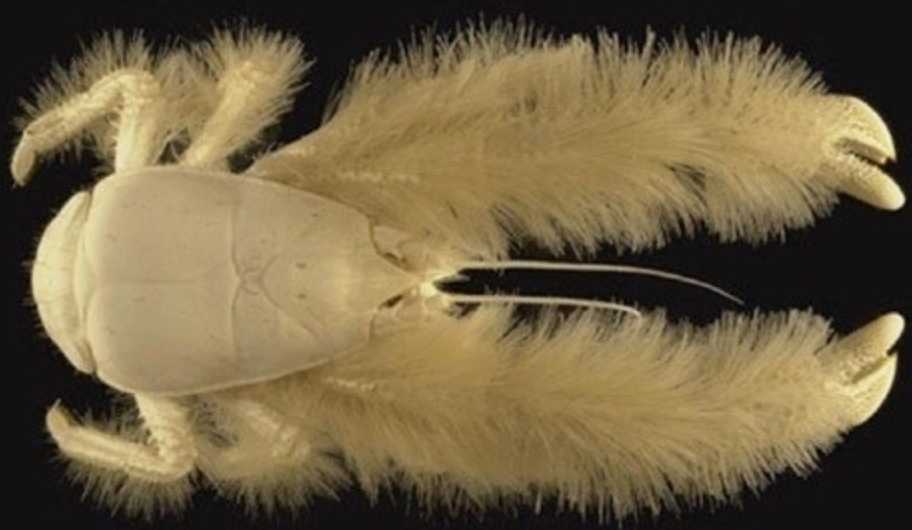
Discovered in 2005 near hydrothermal vents off Easter Island, the yeti crab (Kiwa hirsuta) is a crustacean unlike any other—renowned for its fuzzy, blond "hair" covering its pincers and body, earning it the nickname "yeti crab." This deep-sea dweller thrives in one of Earth’s most extreme environments, relying on a unique partnership with bacteria for survival.


Hairy Armor and Adaptations to the Abyss

  • Feathery Fibrils for Survival
    The crab’s most iconic feature is its dense covering of setae (hair-like structures) on its chelipeds (pincers) and thorax. These fibrils host colonies of chemosynthetic bacteria, which convert toxic hydrogen sulfide from hydrothermal vents into energy—a process called chemosynthesis. The crab "farms" these bacteria by waving its pincers in vent plumes, providing them with nutrients while feeding on their byproducts.
  • Blind but Sensitive
    Lacking functional eyes in the pitch-black depths, it navigates using sensory hairs that detect temperature, chemical gradients, and water movement. Its white exoskeleton reflects the faint light from vent fluids, while a stocky body (reaching 15 cm in length) withstands the crushing pressures of 2,200 meters below sea level.

Life in the Vent Ecosystem

  • Reproduction and Behavior
    Females carry fertilized eggs attached to their abdominal pleopods, protecting them in the toxic vent environment. Mating rituals remain unknown, but researchers suspect they communicate via chemical signals. Unlike many deep-sea creatures, yeti crabs are active crawlers, moving between vent fields to find optimal bacterial growth conditions.
  • Ecological Niche
    As primary consumers in vent ecosystems, they recycle nutrients and serve as prey for larger deep-sea animals like octopuses and fish. Their presence indicates the health of hydrothermal vent communities, which rely on chemosynthesis rather than photosynthesis as an energy base.

Scientific Significance and Conservation Concerns

  • Frontiers of Deep-Sea Biology
    The yeti crab’s discovery revolutionized understanding of life in extreme environments. Its bacterial symbiosis offers clues to early life on Earth and potential extraterrestrial life on ocean worlds like Jupiter’s moon Europa. Genetic studies show it belongs to a unique family (Kiwaidae), diverging from other crabs millions of years ago.
  • Threats from Deep-Sea Mining
    While currently listed as "Data Deficient" by the IUCN, yeti crabs face emerging risks from deep-sea mining operations, which could destroy hydrothermal vent habitats. Their specialized lifestyle makes them highly vulnerable to habitat loss, as they cannot survive outside vent ecosystems.


The yeti crab, with its fuzzy pincers and alien-like existence, embodies the mystery of Earth’s final frontiers. In the pitch-black, scalding-hot depths, it has evolved a survival strategy as remarkable as its appearance—reminding humanity that even in the most inhospitable places, life finds a way to thrive through partnership and adaptation.

Latest Stories
Feline News2 minute readThe Korat cat, originating from Thailand’s Nakhon Ratchasima province (formerly Korat), is a breed deeply rooted in history and cultural significance. Revered for centuries as a symbol of good luck and prosperity, these silver-blue felines have enchanted the world with their striking appearance and affectionate nature.
Feline News2 minute readThe Burmese cat, a breed steeped in history and adored for its regal charm, continues to captivate cat lovers worldwide. Originating from Myanmar (formerly Burma), these medium-sized shorthairs are celebrated for their luxurious coat, affectionate demeanor, and intelligence. Here’s an in-depth look at this ancient breed, combining the latest research and international standards
Feline News2 minute readThe Russian Blue, with its silvery-blue coat and piercing emerald eyes, stands as a paragon of feline elegance, earning the title "Noble of the Shorthairs" 5. Originating from Arkhangelsk Port in Russia—once known as the "Blue Angel Harbor"—this ancient breed derived its name not from color but from its birthplace 3. In 1860, sailors introduced them to Europe, and they debuted at London's Crystal Palace Exposition in 1875 as "Archangel Cats," captivating audiences with their otherworldly allure
Astro Information1 minute readEnceladus, Saturn’s icy moon, harbors a subsurface ocean beneath tiger-stripe fractures that erupt icy particles into space. These geysers form a dense ice cloud over the south pole, feeding Saturn’s faint E ring. The Cassini spacecraft (2004–2017) provided definitive evidence, capturing this true-color, high-resolution image during a close flyby, revealing shadowed ice chasms and active vents.
Animal Information1 minute readNative to Africa, warthogs (Phacochoerus) earn their name from the fleshy facial warts beneath their eyes. Split into the common warthog and desert warthog, these ungulates have heads comprising one-third of their body length, with tusks reaching 64 cm. They subsist on grass roots and tubers, surviving months without water—adaptations that define their harsh savanna lifestyle.
Astro Information2 minute readA close-up from NASA’s Mars Reconnaissance Orbiter (MRO) HiRISE camera unveils the weathered craters and aeolian features of southern Acidalia Planitia. While standard HiRISE imagery often appears in striking blue tones—a result of multispectral processing to enhance geological details—the region would likely appear gray or pale red to human eyes. Of course, no human has yet witnessed this Martian landscape firsthand—unless we count Andy Weir’s fictional NASA astronaut in The Martian.
Feline News1 minute readDubbed the "parlor panther," the Bombay Cat captivates with its jet-black coat and mesmerizing copper-gold eyes, an uncanny resemblance to the wild black leopard. Originating in 1958, Kentucky breeder Nikki Horner meticulously crossed sable Burmese cats with black American Shorthairs, aiming to create a domestic feline embodying both exotic allure and gentle temperament. After years of selective breeding, her vision became reality, establishing the Bombay as a breed that bridges wild aesthetics with affectionate companionship.