The Lion's Mane Jellyfish: The Ocean's Gigantic, Frilly Predator of the Cold Depths


Animal Information
The Lion's Mane Jellyfish: The Ocean's Gigantic, Frilly Predator of the Cold Depths

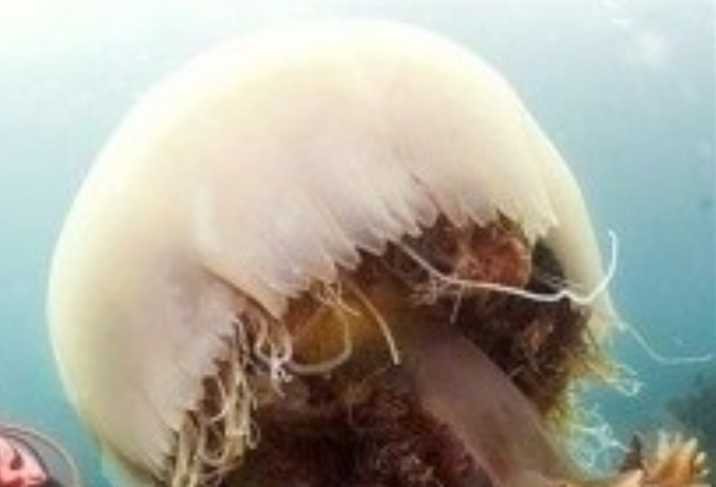
The lion's mane jellyfish (Cyanea capillata) is a majestic and imposing creature, renowned as one of the largest jellyfish species in the world. Found in cold, boreal waters of the Arctic, North Atlantic, and North Pacific oceans, its name stems from its striking appearance—long, flowing tentacles resembling a lion's mane, which give it both beauty and a fearsome reputation as a predator.

A Colossal Frame and Deadly Adaptations

  • Size and Structure:
    The lion's mane jellyfish can reach astounding proportions: its bell (the dome-shaped body) may span up to 2 meters in diameter, while its tentacles—arranged in eight clusters—can stretch up to 30 meters, longer than a blue whale. This massive size makes it a top predator in its ecosystem. The bell is typically reddish-brown or golden, fading to pale pink at the edges, with a frilly oral arm structure beneath that resembles a mane.
  • Toxic Tentacles:
    Each tentacle is lined with thousands of nematocysts (stinging cells) that inject toxins into prey, such as small fish, plankton, and other jellyfish. The venom is designed to paralyze or kill, allowing the jellyfish to draw prey toward its central mouth with its oral arms. While rarely fatal to humans, encounters can cause painful stings and allergic reactions.

Life Cycle and Oceanic Role

  • Metamorphosis and Reproduction:
    Starting as tiny planula larvae, they attach to seafloor substrates and grow into polyps, which eventually bud off into ephyrae (young jellyfish). As adults, they reproduce sexually, releasing eggs and sperm into the water. Their lifespan is relatively short, typically surviving one year, with peak size reached in late summer.
  • Ecological Impact:
    As both predator and prey, lion's mane jellyfish play a key role in marine food webs. They control populations of small marine creatures, while larger animals like sea turtles and sunfish feed on them. Their massive bodies also provide habitat for smaller organisms, such as juvenile fish that seek shelter among their tentacles.

Challenges and Fascination

  • Threats and Resilience:
    While not endangered, lion's mane jellyfish face potential risks from climate change (warmer waters may alter their range) and pollution. Conversely, they can thrive in overfished areas where predators are scarce, sometimes forming large swarms that clog fishing nets or damage industrial equipment.
  • Scientific and Cultural Significance:
    Their unique physiology—including a simple nervous system and lack of a brain or heart—fascinates researchers studying animal evolution and marine biology. In folklore, their imposing presence has inspired tales of sea monsters, while their ethereal movements in the water continue to captivate divers and ocean enthusiasts.


The lion's mane jellyfish stands as a testament to nature's ability to create both beauty and intimidation in the ocean's depths. Its colossal form and ancient lineage remind humanity of the vast, mysterious world beneath the waves—a world where even the most delicate-looking creatures can wield remarkable power.

Latest Stories
Feline News2 minute readThe Korat cat, originating from Thailand’s Nakhon Ratchasima province (formerly Korat), is a breed deeply rooted in history and cultural significance. Revered for centuries as a symbol of good luck and prosperity, these silver-blue felines have enchanted the world with their striking appearance and affectionate nature.
Feline News2 minute readThe Burmese cat, a breed steeped in history and adored for its regal charm, continues to captivate cat lovers worldwide. Originating from Myanmar (formerly Burma), these medium-sized shorthairs are celebrated for their luxurious coat, affectionate demeanor, and intelligence. Here’s an in-depth look at this ancient breed, combining the latest research and international standards
Feline News2 minute readThe Russian Blue, with its silvery-blue coat and piercing emerald eyes, stands as a paragon of feline elegance, earning the title "Noble of the Shorthairs" 5. Originating from Arkhangelsk Port in Russia—once known as the "Blue Angel Harbor"—this ancient breed derived its name not from color but from its birthplace 3. In 1860, sailors introduced them to Europe, and they debuted at London's Crystal Palace Exposition in 1875 as "Archangel Cats," captivating audiences with their otherworldly allure
Astro Information1 minute readEnceladus, Saturn’s icy moon, harbors a subsurface ocean beneath tiger-stripe fractures that erupt icy particles into space. These geysers form a dense ice cloud over the south pole, feeding Saturn’s faint E ring. The Cassini spacecraft (2004–2017) provided definitive evidence, capturing this true-color, high-resolution image during a close flyby, revealing shadowed ice chasms and active vents.
Animal Information1 minute readNative to Africa, warthogs (Phacochoerus) earn their name from the fleshy facial warts beneath their eyes. Split into the common warthog and desert warthog, these ungulates have heads comprising one-third of their body length, with tusks reaching 64 cm. They subsist on grass roots and tubers, surviving months without water—adaptations that define their harsh savanna lifestyle.
Astro Information2 minute readA close-up from NASA’s Mars Reconnaissance Orbiter (MRO) HiRISE camera unveils the weathered craters and aeolian features of southern Acidalia Planitia. While standard HiRISE imagery often appears in striking blue tones—a result of multispectral processing to enhance geological details—the region would likely appear gray or pale red to human eyes. Of course, no human has yet witnessed this Martian landscape firsthand—unless we count Andy Weir’s fictional NASA astronaut in The Martian.
Feline News1 minute readDubbed the "parlor panther," the Bombay Cat captivates with its jet-black coat and mesmerizing copper-gold eyes, an uncanny resemblance to the wild black leopard. Originating in 1958, Kentucky breeder Nikki Horner meticulously crossed sable Burmese cats with black American Shorthairs, aiming to create a domestic feline embodying both exotic allure and gentle temperament. After years of selective breeding, her vision became reality, establishing the Bombay as a breed that bridges wild aesthetics with affectionate companionship.