The International Space Station Transit: A Fleeting Solar Spectacle


Astro Information
The International Space Station Transit: A Fleeting Solar Spectacle

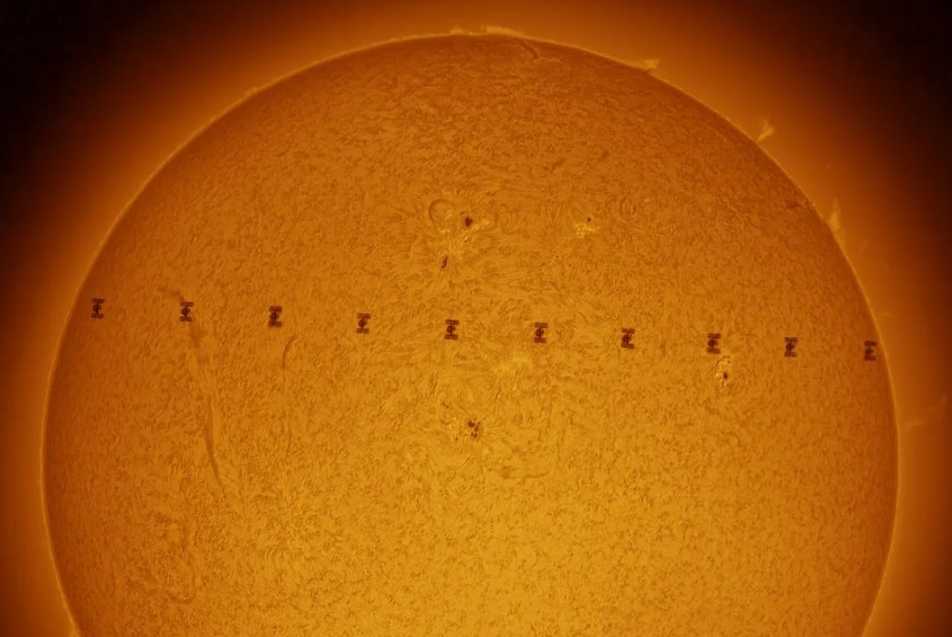
When the International Space Station (ISS) streaks across the Sun’s disk at 8 km/s, its 0.8-second transit freezes human ingenuity and stellar dynamics on the same cosmic canvas. This rare phenomenon defies the ISS’s usual visibility—typically a bright speck in twilight—occurring only when orbital mechanics align the station, Earth, and Sun with precision.

From "Celestial Speck" to Silhouette: The Science of Visibility

  • Normal Observation: The ISS shines by reflecting sunlight, visible for 30 minutes after sunset or before sunrise when it orbits outside Earth’s shadow. At magnitude -4, it outshines Jupiter, appearing as a 匀速 moving dot.
  • Transit Anomaly: During a transit, the ISS blocks sunlight, forming a silhouette. This requires daytime visibility and a strict alignment of the station’s orbit with the Sun’s disk—occurring only a few times annually over narrow ground paths (e.g., the 200m-wide window in Sant Feliu de Buixelleu, Spain).

The 0.8-Second Shutter Challenge: Technology Behind the Capture

Photographing the transit demands three technical feats:


  1. Equipment Precision: 1/1000+ second exposure cameras with H-α filters to shield against solar glare.
  2. Orbital Prediction: NASA’s Spot the Station tool calculates ISS trajectories with sub-second accuracy.
  3. Image Synthesis: This composite merges:
    • Multiple transit frames (capturing the ISS’s T-shaped outline of solar panels and modules).
    • High-res solar activity data (overlaying details like magnetic loops in active regions and chromospheric prominences).


Note: Prominences are 100,000°C plasma arcs extending tens of thousands of km, glowing red in H-α filters.

A Double Exposure of Science and Art

The composite reveals:


  • Active Region Jets: Dark sunspot groups unleash high-energy particles at hundreds of km/s.
  • Prominence Magnetism: Arc-shaped structures trace magnetic fields trapping plasma, evolving with solar dynamics.
  • Orbital Validation: The silhouette’s scale confirms the ISS’s 400km altitude, verifying astrodynamic models.

Extending the Cosmic Ruler: Transits as Scientific Tools

From Venus transits (used to measure the Astronomical Unit in 1761) to exoplanet detections via transit photometry, these events serve as cosmic yardsticks. The ISS transit adds to this legacy: atmospheric turbulence blurs the silhouette, providing data for telescope site 评估.


This Spanish composite—blending steel machinery with a 1.4 million km-diameter star—encapsulates humanity’s place in the cosmos: a 420-ton spacecraft, tiny against the Sun, yet luminous through engineered design.
Latest Stories
Feline News2 minute readThe Korat cat, originating from Thailand’s Nakhon Ratchasima province (formerly Korat), is a breed deeply rooted in history and cultural significance. Revered for centuries as a symbol of good luck and prosperity, these silver-blue felines have enchanted the world with their striking appearance and affectionate nature.
Feline News2 minute readThe Burmese cat, a breed steeped in history and adored for its regal charm, continues to captivate cat lovers worldwide. Originating from Myanmar (formerly Burma), these medium-sized shorthairs are celebrated for their luxurious coat, affectionate demeanor, and intelligence. Here’s an in-depth look at this ancient breed, combining the latest research and international standards
Feline News2 minute readThe Russian Blue, with its silvery-blue coat and piercing emerald eyes, stands as a paragon of feline elegance, earning the title "Noble of the Shorthairs" 5. Originating from Arkhangelsk Port in Russia—once known as the "Blue Angel Harbor"—this ancient breed derived its name not from color but from its birthplace 3. In 1860, sailors introduced them to Europe, and they debuted at London's Crystal Palace Exposition in 1875 as "Archangel Cats," captivating audiences with their otherworldly allure
Astro Information1 minute readEnceladus, Saturn’s icy moon, harbors a subsurface ocean beneath tiger-stripe fractures that erupt icy particles into space. These geysers form a dense ice cloud over the south pole, feeding Saturn’s faint E ring. The Cassini spacecraft (2004–2017) provided definitive evidence, capturing this true-color, high-resolution image during a close flyby, revealing shadowed ice chasms and active vents.
Animal Information1 minute readNative to Africa, warthogs (Phacochoerus) earn their name from the fleshy facial warts beneath their eyes. Split into the common warthog and desert warthog, these ungulates have heads comprising one-third of their body length, with tusks reaching 64 cm. They subsist on grass roots and tubers, surviving months without water—adaptations that define their harsh savanna lifestyle.
Astro Information2 minute readA close-up from NASA’s Mars Reconnaissance Orbiter (MRO) HiRISE camera unveils the weathered craters and aeolian features of southern Acidalia Planitia. While standard HiRISE imagery often appears in striking blue tones—a result of multispectral processing to enhance geological details—the region would likely appear gray or pale red to human eyes. Of course, no human has yet witnessed this Martian landscape firsthand—unless we count Andy Weir’s fictional NASA astronaut in The Martian.
Feline News1 minute readDubbed the "parlor panther," the Bombay Cat captivates with its jet-black coat and mesmerizing copper-gold eyes, an uncanny resemblance to the wild black leopard. Originating in 1958, Kentucky breeder Nikki Horner meticulously crossed sable Burmese cats with black American Shorthairs, aiming to create a domestic feline embodying both exotic allure and gentle temperament. After years of selective breeding, her vision became reality, establishing the Bombay as a breed that bridges wild aesthetics with affectionate companionship.