The Frigatebird: Tropical Oceans’ Aerial Pirates and Sleep-in-Flight Specialists


Bird Information
The Frigatebird: Tropical Oceans’ Aerial Pirates and Sleep-in-Flight Specialists

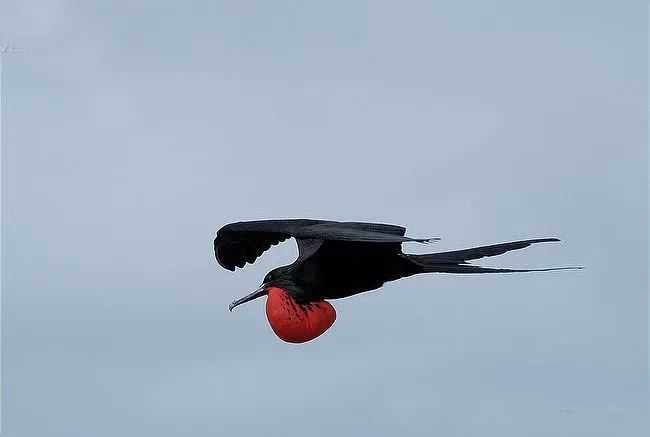
Living primarily in tropical oceans, frigatebirds boast wingspans exceeding 2 meters, with males sporting a distinctive red throat pouch that inflates like a scarlet balloon during courtship. These avian marvels are renowned for their ability to fly continuously for two months without touching water—even sleeping mid-air.


A 2016 study in Nature Communications revealed their extraordinary sleep strategy: frigatebirds engage in unihemispheric sleep, shutting down one brain hemisphere while the other stays alert. They even experience brief periods of whole-brain sleep lasting several seconds, all while maintaining flight altitude and direction. This allows them to navigate vast oceanic expanses without descending to the water’s surface.


Their flight adaptations are evolutionary masterpieces: lightweight bones, long narrow wings, and a streamlined body enable them to harness wind currents for days on end. "Frigatebirds are nature’s ultimate gliders," says ornithologist Dr. Maria Torres. "They ride updrafts from thunderstorms and soar above trade winds, expending almost no energy as they traverse thousands of kilometers."


The red throat pouch of males serves a dual purpose: a visual signal to attract mates and a thermoregulatory tool in tropical heat. During courtship, males inflate the pouch to impressive sizes, creating a vibrant display against the ocean backdrop. "It’s like a living billboard shouting ‘fitness’ to passing females," notes evolutionary biologist Dr. James Okello.


While they excel in the air, frigatebirds face challenges at sea—their feathers aren’t waterproof, so they avoid landing on water. Instead, they snatch prey from the surface or harass other seabirds to steal their catches, earning the nickname "pirates of the sky."


Conservation efforts focus on protecting nesting colonies from human disturbance. For researchers, studying their sleep patterns has unlocked insights into avian physiology. "Watching a frigatebird circle high above the ocean, it’s easy to forget it might be napping mid-flight," says photographer Maya Singh. "In the vast blue expanse, these birds prove that nature’s innovations know no bounds—even sleep can be reimagined as a tool for survival in the sky."
Latest Stories
Feline News2 minute readThe Korat cat, originating from Thailand’s Nakhon Ratchasima province (formerly Korat), is a breed deeply rooted in history and cultural significance. Revered for centuries as a symbol of good luck and prosperity, these silver-blue felines have enchanted the world with their striking appearance and affectionate nature.
Feline News2 minute readThe Burmese cat, a breed steeped in history and adored for its regal charm, continues to captivate cat lovers worldwide. Originating from Myanmar (formerly Burma), these medium-sized shorthairs are celebrated for their luxurious coat, affectionate demeanor, and intelligence. Here’s an in-depth look at this ancient breed, combining the latest research and international standards
Feline News2 minute readThe Russian Blue, with its silvery-blue coat and piercing emerald eyes, stands as a paragon of feline elegance, earning the title "Noble of the Shorthairs" 5. Originating from Arkhangelsk Port in Russia—once known as the "Blue Angel Harbor"—this ancient breed derived its name not from color but from its birthplace 3. In 1860, sailors introduced them to Europe, and they debuted at London's Crystal Palace Exposition in 1875 as "Archangel Cats," captivating audiences with their otherworldly allure
Astro Information1 minute readEnceladus, Saturn’s icy moon, harbors a subsurface ocean beneath tiger-stripe fractures that erupt icy particles into space. These geysers form a dense ice cloud over the south pole, feeding Saturn’s faint E ring. The Cassini spacecraft (2004–2017) provided definitive evidence, capturing this true-color, high-resolution image during a close flyby, revealing shadowed ice chasms and active vents.
Animal Information1 minute readNative to Africa, warthogs (Phacochoerus) earn their name from the fleshy facial warts beneath their eyes. Split into the common warthog and desert warthog, these ungulates have heads comprising one-third of their body length, with tusks reaching 64 cm. They subsist on grass roots and tubers, surviving months without water—adaptations that define their harsh savanna lifestyle.
Astro Information2 minute readA close-up from NASA’s Mars Reconnaissance Orbiter (MRO) HiRISE camera unveils the weathered craters and aeolian features of southern Acidalia Planitia. While standard HiRISE imagery often appears in striking blue tones—a result of multispectral processing to enhance geological details—the region would likely appear gray or pale red to human eyes. Of course, no human has yet witnessed this Martian landscape firsthand—unless we count Andy Weir’s fictional NASA astronaut in The Martian.
Feline News1 minute readDubbed the "parlor panther," the Bombay Cat captivates with its jet-black coat and mesmerizing copper-gold eyes, an uncanny resemblance to the wild black leopard. Originating in 1958, Kentucky breeder Nikki Horner meticulously crossed sable Burmese cats with black American Shorthairs, aiming to create a domestic feline embodying both exotic allure and gentle temperament. After years of selective breeding, her vision became reality, establishing the Bombay as a breed that bridges wild aesthetics with affectionate companionship.