The Fireworks Jellyfish: Deep-Sea Marvel Illuminating 1,200–1,500 Meters Below the Surface


Marine Biology
The Fireworks Jellyfish: Deep-Sea Marvel Illuminating 1,200–1,500 Meters Below the Surface

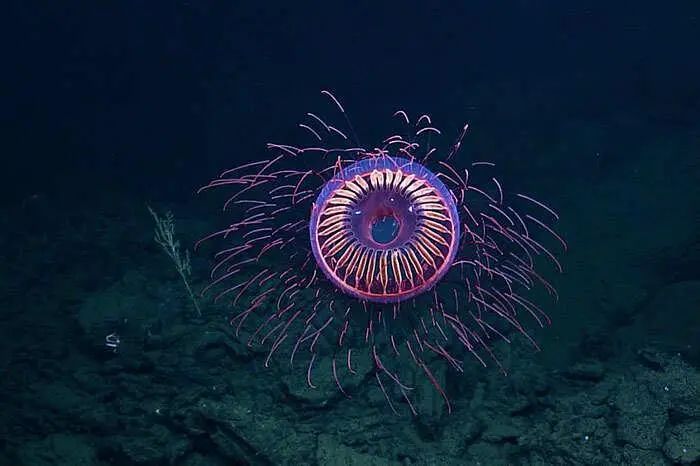
Discovered in the pitch-black abyssal zone, the fireworks jellyfish (Halitrephes maasi) earns its name from its spectacular bioluminescent display—vibrant orange and pink tentacles that explode like celestial pyrotechnics in the ocean’s darkest depths. Thriving between 1,200 and 1,500 meters, this gelatinous creature has captivated marine biologists with its otherworldly appearance and mysterious life cycle.


A Living Explosion in the Abyss: Anatomy and Adaptations

  • Bioluminescence as a Survival Tool
    The jellyfish features a bell-shaped body up to 15 cm in diameter, ringed by long, branching tentacles coated in photophores—organs that emit bright orange and pink light. This glow, triggered by chemical reactions, serves dual purposes: attracting prey (such as small crustaceans) and confusing predators. The light patterns mimic the disorienting effect of a fireworks show, allowing the jellyfish to escape or ambush.
  • Structure for Extreme Pressure
    Its gelatinous body is adapted to withstand the crushing pressure of the deep sea, with a transparent bell that reduces drag as it drifts. Unlike shallow-water jellyfish, it lacks a prominent mouth, instead absorbing nutrients through its tentacles, which are covered in sticky cells to capture plankton.

Life in the Lightless Depths

  • Feeding and Locomotion
    The fireworks jellyfish floats slowly, using gentle pulsations of its bell to move. Its tentacles trail behind, spread wide to intercept passing prey. When threatened, it can retract its tentacles and increase its bioluminescent glow, potentially signaling to larger predators to deter attackers.
  • Rarity and Research Challenges
    Due to its deep-sea habitat, the species is rarely observed, with most sightings coming from remotely operated vehicles (ROVs). Scientists believe it reproduces sexually, releasing eggs and sperm into the water, but details about its lifecycle remain unknown. Its distribution is thought to be global in temperate and tropical oceans, though confirmed sightings are limited to the Pacific and Atlantic.

Ecological Significance and Conservation

While the fireworks jellyfish’s exact role in deep-sea ecosystems is unclear, it serves as a vital food source for larger abyssal creatures like grenadiers and gulper eels. Its bioluminescence also contributes to the "twilight zone" of the ocean, where light signals are crucial for communication and survival.


As deep-sea mining and climate change threaten these fragile ecosystems, the fireworks jellyfish stands as a symbol of the ocean’s undiscovered wonders. Its ephemeral glow reminds humanity of the urgent need to protect the abyss—where life evolves in ways that challenge imagination, and every flash of light holds secrets yet to be uncovered.
Latest Stories
Feline News2 minute readThe Korat cat, originating from Thailand’s Nakhon Ratchasima province (formerly Korat), is a breed deeply rooted in history and cultural significance. Revered for centuries as a symbol of good luck and prosperity, these silver-blue felines have enchanted the world with their striking appearance and affectionate nature.
Feline News2 minute readThe Burmese cat, a breed steeped in history and adored for its regal charm, continues to captivate cat lovers worldwide. Originating from Myanmar (formerly Burma), these medium-sized shorthairs are celebrated for their luxurious coat, affectionate demeanor, and intelligence. Here’s an in-depth look at this ancient breed, combining the latest research and international standards
Feline News2 minute readThe Russian Blue, with its silvery-blue coat and piercing emerald eyes, stands as a paragon of feline elegance, earning the title "Noble of the Shorthairs" 5. Originating from Arkhangelsk Port in Russia—once known as the "Blue Angel Harbor"—this ancient breed derived its name not from color but from its birthplace 3. In 1860, sailors introduced them to Europe, and they debuted at London's Crystal Palace Exposition in 1875 as "Archangel Cats," captivating audiences with their otherworldly allure
Astro Information1 minute readEnceladus, Saturn’s icy moon, harbors a subsurface ocean beneath tiger-stripe fractures that erupt icy particles into space. These geysers form a dense ice cloud over the south pole, feeding Saturn’s faint E ring. The Cassini spacecraft (2004–2017) provided definitive evidence, capturing this true-color, high-resolution image during a close flyby, revealing shadowed ice chasms and active vents.
Animal Information1 minute readNative to Africa, warthogs (Phacochoerus) earn their name from the fleshy facial warts beneath their eyes. Split into the common warthog and desert warthog, these ungulates have heads comprising one-third of their body length, with tusks reaching 64 cm. They subsist on grass roots and tubers, surviving months without water—adaptations that define their harsh savanna lifestyle.
Astro Information2 minute readA close-up from NASA’s Mars Reconnaissance Orbiter (MRO) HiRISE camera unveils the weathered craters and aeolian features of southern Acidalia Planitia. While standard HiRISE imagery often appears in striking blue tones—a result of multispectral processing to enhance geological details—the region would likely appear gray or pale red to human eyes. Of course, no human has yet witnessed this Martian landscape firsthand—unless we count Andy Weir’s fictional NASA astronaut in The Martian.
Feline News1 minute readDubbed the "parlor panther," the Bombay Cat captivates with its jet-black coat and mesmerizing copper-gold eyes, an uncanny resemblance to the wild black leopard. Originating in 1958, Kentucky breeder Nikki Horner meticulously crossed sable Burmese cats with black American Shorthairs, aiming to create a domestic feline embodying both exotic allure and gentle temperament. After years of selective breeding, her vision became reality, establishing the Bombay as a breed that bridges wild aesthetics with affectionate companionship.