The Cosmic Crucible: How Stars Are Born—Insights from W5's Infrared Portrait


Astro Information
The Cosmic Crucible: How Stars Are Born—Insights from W5's Infrared Portrait

The Core Processes of Star Formation: Gravity and Gas in Cosmic Ballet Stars emerge from dense molecular clouds (composed mainly of hydrogen molecules and dust), with their formation unfolding in critical stages:

The Cosmic Crucible: How Stars Are Born—Insights from W5's Infrared Portrait

I. The Core Processes of Star Formation: Gravity and Gas in Cosmic Ballet

Stars emerge from dense molecular clouds (composed mainly of hydrogen molecules and dust), with their formation unfolding in critical stages:
Source: Images from the Internet, if there is any infringement, please contact the removal of


1. Gravitational Collapse of Molecular Clouds: Triggering Jeans Instability
  • Initial Conditions: Molecular clouds balance self-gravity, magnetic fields, and turbulent pressure. When a cloud’s mass exceeds the Jeans mass (20–1,000 solar masses, dependent on temperature/density), gravity overcomes gas pressure, initiating collapse.
  • Dust’s Role: Dust grains act as "cosmic nuclei," reducing cloud temperature via heat absorption/radiation, enhancing gravitational instability.
2. Formation of Protostars and Accretion Disks
  • Collapsing Core: A protostar forms first at the cloud’s center, surrounded by a rotating accretion disk. Material falls toward the core, releasing gravitational energy that heats the protostar.
  • Outflows and Jets: High-speed jets (e.g., Herbig-Haro objects) erupt from the protostar’s poles, while stellar winds at the disk’s edge disperse surrounding gas, preventing excessive accretion.
3. Birth of a Main-Sequence Star: Nuclear Fusion Ignition
When the protostar’s core temperature exceeds 10 million K, hydrogen fusion to helium begins, launching the star into the main sequence. Radiation pressure balances gravity, stabilizing the celestial body.

II. The W5 Star-Forming Region: Massive Stars as Cosmic 'Star Factories'

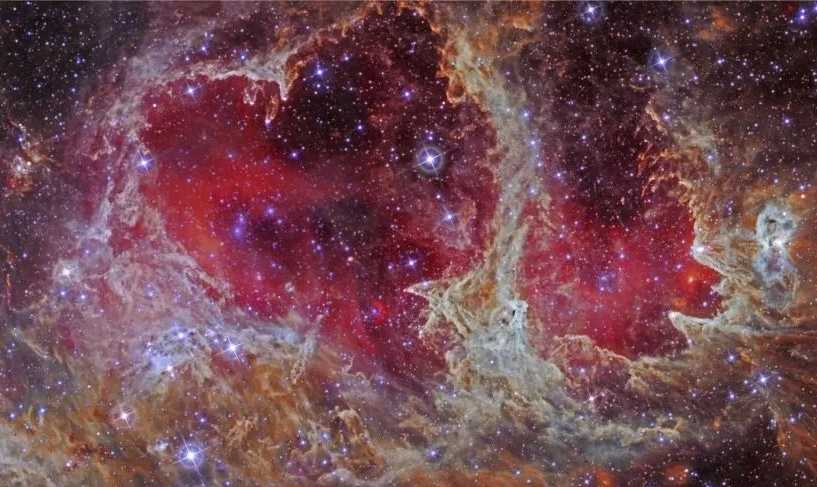
NASA’s NEOWISE satellite (formerly WISE) captured the W5 region (6,500 light-years away) in infrared, revealing the trigger mechanism of star formation:
1. The Hollow and Central Stars: 'First Movers' in Cosmic Time
  • W5 harbors a 50-light-year-wide giant hollow with massive stars (e.g., O-type stars) at its center, forming 1–2 million years earlier than edge stars.
  • Cause: Massive stars have short lifespans (millions of years). Their intense UV radiation, stellar winds, and eventual supernovae "carve out" the hollow.
2. How Central Stars 'Ignite' New Stars at the Edge
  • Compression by Outflowing Gas: Hot outflows from central stars (hundreds of km/s) collide with surrounding cold molecular clouds (10–20K), compressing gas into dense clumps (density >10⁴ molecules/cm³).
  • Chain Reaction of Gravitational Collapse: Compressed clumps meet Jeans instability criteria, collapsing to form new stars. W5’s edge hosts young stars (1–0.5 million years old), creating an "old center, young edge" age gradient.
3. The 'X-Ray Vision' of Infrared Imaging
  • Visible light is blocked by dust, but NEOWISE’s infrared bands (3.4–22 microns) penetrate it, revealing:
    • Red glows: Heated dust (from stellar radiation);
    • Blue : Newborn stars (hotter, stronger infrared emission).

III. The 'Chain Reaction' of Star Formation: Cosmic Spark Transmission

W5 exemplifies the self-propagating mechanism of star formation: massive stars are both "star makers" and "space cleaners." Their activity shapes the interstellar medium, driving next-generation star birth, as seen in:


  • Orion Nebula: The central Trapezium cluster’s winds compress surrounding gas, forming "star nurseries."
  • Eagle Nebula’s 'Pillars of Creation': Shockwaves from supernovae trigger protostars within the pillars.

IV. Observational Validation of Star Formation Theories

Data from NEOWISE and other telescopes (e.g., W5’s infrared spectra) supports theoretical models:


  • Computer Simulations: Hydrodynamic models replicate outflow gas compression, matching W5’s hollow-edge structure.
  • Cluster Age Distribution: The 1.5-million-year age gap between W5’s central and edge stars aligns with the time scale of massive-star-triggered formation.


Conclusion: Star birth is not just a physical process of gravity and gas but a pivotal link in the universe’s matter-energy cycle. From W5’s "cosmic seagull" to the Milky Way’s hundred billion stars, each stellar birth continues the epic of galactic evolution. Infrared telescopes are unveiling the mysteries of this cosmic "origin story"—a testament to the universe’s enduring capacity for creation.
Latest Stories
Feline News2 minute readThe Korat cat, originating from Thailand’s Nakhon Ratchasima province (formerly Korat), is a breed deeply rooted in history and cultural significance. Revered for centuries as a symbol of good luck and prosperity, these silver-blue felines have enchanted the world with their striking appearance and affectionate nature.
Feline News2 minute readThe Burmese cat, a breed steeped in history and adored for its regal charm, continues to captivate cat lovers worldwide. Originating from Myanmar (formerly Burma), these medium-sized shorthairs are celebrated for their luxurious coat, affectionate demeanor, and intelligence. Here’s an in-depth look at this ancient breed, combining the latest research and international standards
Feline News2 minute readThe Russian Blue, with its silvery-blue coat and piercing emerald eyes, stands as a paragon of feline elegance, earning the title "Noble of the Shorthairs" 5. Originating from Arkhangelsk Port in Russia—once known as the "Blue Angel Harbor"—this ancient breed derived its name not from color but from its birthplace 3. In 1860, sailors introduced them to Europe, and they debuted at London's Crystal Palace Exposition in 1875 as "Archangel Cats," captivating audiences with their otherworldly allure
Astro Information1 minute readEnceladus, Saturn’s icy moon, harbors a subsurface ocean beneath tiger-stripe fractures that erupt icy particles into space. These geysers form a dense ice cloud over the south pole, feeding Saturn’s faint E ring. The Cassini spacecraft (2004–2017) provided definitive evidence, capturing this true-color, high-resolution image during a close flyby, revealing shadowed ice chasms and active vents.
Animal Information1 minute readNative to Africa, warthogs (Phacochoerus) earn their name from the fleshy facial warts beneath their eyes. Split into the common warthog and desert warthog, these ungulates have heads comprising one-third of their body length, with tusks reaching 64 cm. They subsist on grass roots and tubers, surviving months without water—adaptations that define their harsh savanna lifestyle.
Astro Information2 minute readA close-up from NASA’s Mars Reconnaissance Orbiter (MRO) HiRISE camera unveils the weathered craters and aeolian features of southern Acidalia Planitia. While standard HiRISE imagery often appears in striking blue tones—a result of multispectral processing to enhance geological details—the region would likely appear gray or pale red to human eyes. Of course, no human has yet witnessed this Martian landscape firsthand—unless we count Andy Weir’s fictional NASA astronaut in The Martian.
Feline News1 minute readDubbed the "parlor panther," the Bombay Cat captivates with its jet-black coat and mesmerizing copper-gold eyes, an uncanny resemblance to the wild black leopard. Originating in 1958, Kentucky breeder Nikki Horner meticulously crossed sable Burmese cats with black American Shorthairs, aiming to create a domestic feline embodying both exotic allure and gentle temperament. After years of selective breeding, her vision became reality, establishing the Bombay as a breed that bridges wild aesthetics with affectionate companionship.