The Colorado Potato Beetle (Leptinotarsa decemlineata): A Persistent Agricultural Menace


Insect Information
The Colorado Potato Beetle (Leptinotarsa decemlineata): A Persistent Agricultural Menace

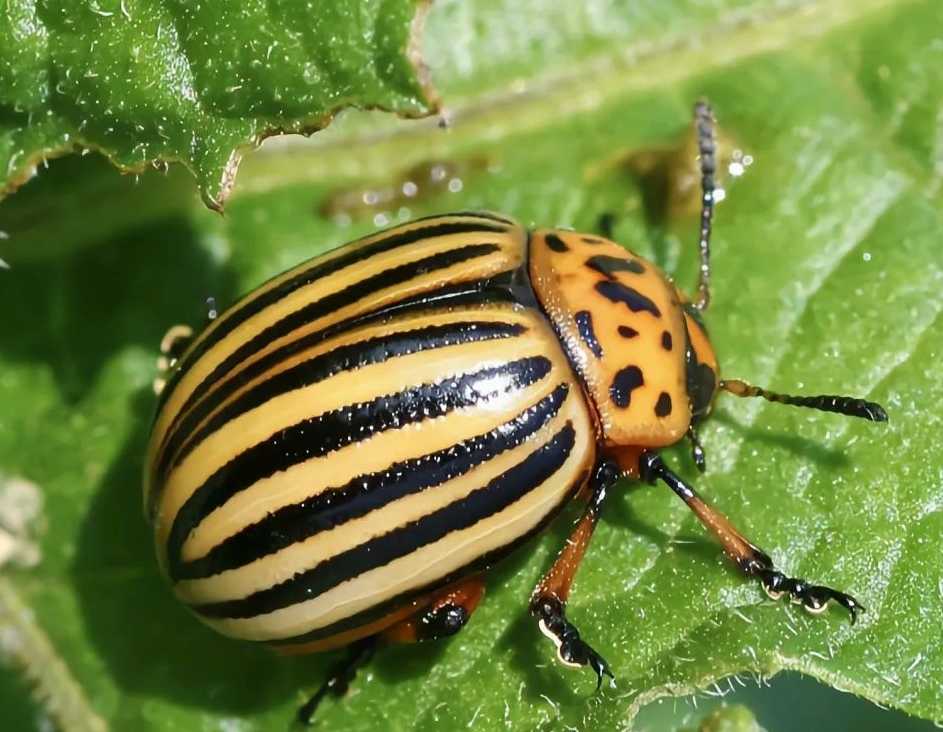
The Colorado potato beetle, scientifically known as Leptinotarsa decemlineata, is a notorious insect pest recognized by its distinctive yellow-orange elytra striped with ten black longitudinal lines. Native to North America, this beetle has earned global infamy for its voracious appetite for potato leaves and its remarkable ability to develop resistance to pesticides, making it a top quarantine target worldwide.

Morphology and Life Cycle

  • Physical Characteristics: Adults measure 7–12 mm, with oval bodies marked by the iconic black-and-yellow stripes. Larvae are plump, bright orange-red, and covered in dark tubercles, while pupae transform in soil before emerging as adults. This vivid coloration serves as a warning to predators, as both larvae and adults secrete toxic compounds from their legs.
  • Rapid Reproduction: Females lay up to 500 eggs on the undersides of potato leaves, and a single generation can develop in as little as 30 days. This short life cycle allows populations to explode, especially in warm, agricultural regions.

Ecological Impact and Agricultural Threat

  • Specialized Feeding Habits: True to its name, the beetle specializes in feeding on solanaceous plants, particularly potatoes (Solanum tuberosum), but also targets tomatoes, eggplants, and peppers. Larvae and adults strip leaves down to the veins, reducing crop yields by up to 90% if left uncontrolled.
  • Pesticide Resistance: Over decades of chemical control, the beetle has evolved resistance to more than 50 insecticides, including organophosphates, pyrethroids, and neonicotinoids. This resistance arises from genetic mutations that enhance detoxification enzymes or alter pesticide targets, making it a model organism for studying insecticide resistance mechanisms.

Global Spread and Quarantine Measures

  • Invasive Journey: Originating in the Rocky Mountains, the beetle followed potato cultivation westward in the 19th century and crossed the Atlantic in the early 1900s. Today, it infests potato farms in Europe, Asia, and North Africa, prompting strict international quarantine protocols.
  • Management Challenges: Farmers employ integrated pest management (IPM) strategies, including crop rotation, biological control (using natural enemies like parasitic wasps), and genetically modified potatoes producing insecticidal proteins. However, the beetle’s adaptability often outpaces these efforts.

Scientific Significance and Cultural Notes

  • Model for Pest Research: The beetle’s genome has been sequenced, aiding studies on insect-plant interactions, pesticide resistance, and evolutionary biology. Its ability to rapidly adapt to new hosts and toxins makes it a critical case study in invasive species management.
  • Cultural References: In popular culture, the beetle symbolizes agricultural adversity, appearing in literature and documentaries about sustainable farming. Its nickname, the "striped bandit," reflects farmers’ frustration with its destructive habits.

Future Outlook and Conservation

As climate change expands suitable habitats for the beetle, researchers race to develop novel control methods, such as RNA interference (RNAi) targeting specific genes or pheromone-based traps to disrupt mating. However, the beetle’s resilience underscores the need for global cooperation in pest management—proof that even a small, striped insect can pose a massive challenge to global food security.


From its humble origins in North American prairies to its status as a worldwide agricultural foe, the Colorado potato beetle exemplifies the complex relationship between humans, plants, and pests. Its story serves as a warning: in the battle against invasive species, adaptability often determines survival—and this striped adversary shows no signs of surrender.

Latest Stories
Feline News2 minute readThe Korat cat, originating from Thailand’s Nakhon Ratchasima province (formerly Korat), is a breed deeply rooted in history and cultural significance. Revered for centuries as a symbol of good luck and prosperity, these silver-blue felines have enchanted the world with their striking appearance and affectionate nature.
Feline News2 minute readThe Burmese cat, a breed steeped in history and adored for its regal charm, continues to captivate cat lovers worldwide. Originating from Myanmar (formerly Burma), these medium-sized shorthairs are celebrated for their luxurious coat, affectionate demeanor, and intelligence. Here’s an in-depth look at this ancient breed, combining the latest research and international standards
Feline News2 minute readThe Russian Blue, with its silvery-blue coat and piercing emerald eyes, stands as a paragon of feline elegance, earning the title "Noble of the Shorthairs" 5. Originating from Arkhangelsk Port in Russia—once known as the "Blue Angel Harbor"—this ancient breed derived its name not from color but from its birthplace 3. In 1860, sailors introduced them to Europe, and they debuted at London's Crystal Palace Exposition in 1875 as "Archangel Cats," captivating audiences with their otherworldly allure
Astro Information1 minute readEnceladus, Saturn’s icy moon, harbors a subsurface ocean beneath tiger-stripe fractures that erupt icy particles into space. These geysers form a dense ice cloud over the south pole, feeding Saturn’s faint E ring. The Cassini spacecraft (2004–2017) provided definitive evidence, capturing this true-color, high-resolution image during a close flyby, revealing shadowed ice chasms and active vents.
Animal Information1 minute readNative to Africa, warthogs (Phacochoerus) earn their name from the fleshy facial warts beneath their eyes. Split into the common warthog and desert warthog, these ungulates have heads comprising one-third of their body length, with tusks reaching 64 cm. They subsist on grass roots and tubers, surviving months without water—adaptations that define their harsh savanna lifestyle.
Astro Information2 minute readA close-up from NASA’s Mars Reconnaissance Orbiter (MRO) HiRISE camera unveils the weathered craters and aeolian features of southern Acidalia Planitia. While standard HiRISE imagery often appears in striking blue tones—a result of multispectral processing to enhance geological details—the region would likely appear gray or pale red to human eyes. Of course, no human has yet witnessed this Martian landscape firsthand—unless we count Andy Weir’s fictional NASA astronaut in The Martian.
Feline News1 minute readDubbed the "parlor panther," the Bombay Cat captivates with its jet-black coat and mesmerizing copper-gold eyes, an uncanny resemblance to the wild black leopard. Originating in 1958, Kentucky breeder Nikki Horner meticulously crossed sable Burmese cats with black American Shorthairs, aiming to create a domestic feline embodying both exotic allure and gentle temperament. After years of selective breeding, her vision became reality, establishing the Bombay as a breed that bridges wild aesthetics with affectionate companionship.