The Cassowary: Australia’s Ancient Bird with Claws That Can Slash Through Hard Objects


Animal Information
The Cassowary: Australia’s Ancient Bird with Claws That Can Slash Through Hard Objects

Native to the rainforests of Australia and New Guinea, the cassowary (Casuarius casuarius) stands as one of the world’s oldest bird species, renowned for its prehistoric appearance and formidable defensive capabilities. This flightless bird, often called the "rainforest dinosaur," has survived for millions of years, and its sharp claws have earned it a reputation as one of the most dangerous birds on the planet.


Ancient Heritage and Physical Prowess

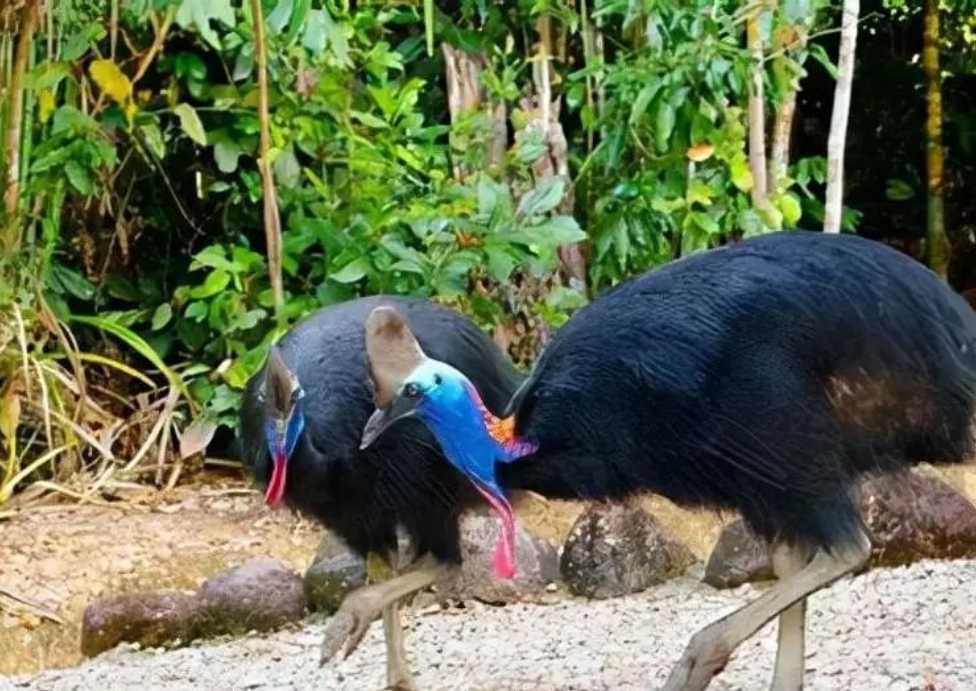
The cassowary’s lineage dates back to the time of the dinosaurs, making it a living relic of avian evolution. Standing up to 1.8 meters tall and weighing over 60 kilograms, it boasts a distinctive blue head, a bony casque on its crown, and a vibrant red wattle hanging from its neck. But its most fearsome feature is the pair of dagger-like claws on each foot, specifically the inner toe, which can grow up to 12 centimeters long. These claws are razor-sharp and curved, designed to slash through dense vegetation, defend against predators, or tear apart hard-shelled fruits and small prey.

Powerful Claws: Tools for Survival and Defense

In the wild, cassowaries use their claws primarily for foraging and self-defense. They scratch the forest floor to uncover seeds, fungi, and insects, and their powerful legs allow them to kick with incredible force—capable of breaking bones or tearing through tough materials like tree bark and thick foliage. When threatened, a cassowary can lunge forward and deliver a slashing kick that has been known to injure humans and other animals. Despite their aggressive reputation, they are generally shy and only attack when provoked, such as when defending their nests or chicks.

Conservation and Ecological Role

Listed as Vulnerable by the IUCN, cassowaries face threats from habitat loss, vehicle collisions, and human interference. Their rainforest homes are being destroyed by deforestation, and climate change is altering their food sources. As important seed dispersers, cassowaries play a crucial role in maintaining forest health, helping to spread the seeds of native plants across their range. Conservation efforts in Australia, including habitat protection and public education, aim to safeguard both the species and its ancient ecosystem.


The cassowary’s existence is a testament to the resilience of prehistoric life, proving that some of Earth’s oldest creatures still roam the planet. Its fearsome claws, evolved over millions of years for survival, serve as a reminder of the raw power of nature and the urgent need to protect these living links to our planet’s distant past. As we strive to preserve Australia’s unique biodiversity, the cassowary stands as a symbol of the wild, untamed beauty that still thrives in our world’s last great rainforests.
Latest Stories
Feline News2 minute readThe Korat cat, originating from Thailand’s Nakhon Ratchasima province (formerly Korat), is a breed deeply rooted in history and cultural significance. Revered for centuries as a symbol of good luck and prosperity, these silver-blue felines have enchanted the world with their striking appearance and affectionate nature.
Feline News2 minute readThe Burmese cat, a breed steeped in history and adored for its regal charm, continues to captivate cat lovers worldwide. Originating from Myanmar (formerly Burma), these medium-sized shorthairs are celebrated for their luxurious coat, affectionate demeanor, and intelligence. Here’s an in-depth look at this ancient breed, combining the latest research and international standards
Feline News2 minute readThe Russian Blue, with its silvery-blue coat and piercing emerald eyes, stands as a paragon of feline elegance, earning the title "Noble of the Shorthairs" 5. Originating from Arkhangelsk Port in Russia—once known as the "Blue Angel Harbor"—this ancient breed derived its name not from color but from its birthplace 3. In 1860, sailors introduced them to Europe, and they debuted at London's Crystal Palace Exposition in 1875 as "Archangel Cats," captivating audiences with their otherworldly allure
Astro Information1 minute readEnceladus, Saturn’s icy moon, harbors a subsurface ocean beneath tiger-stripe fractures that erupt icy particles into space. These geysers form a dense ice cloud over the south pole, feeding Saturn’s faint E ring. The Cassini spacecraft (2004–2017) provided definitive evidence, capturing this true-color, high-resolution image during a close flyby, revealing shadowed ice chasms and active vents.
Animal Information1 minute readNative to Africa, warthogs (Phacochoerus) earn their name from the fleshy facial warts beneath their eyes. Split into the common warthog and desert warthog, these ungulates have heads comprising one-third of their body length, with tusks reaching 64 cm. They subsist on grass roots and tubers, surviving months without water—adaptations that define their harsh savanna lifestyle.
Astro Information2 minute readA close-up from NASA’s Mars Reconnaissance Orbiter (MRO) HiRISE camera unveils the weathered craters and aeolian features of southern Acidalia Planitia. While standard HiRISE imagery often appears in striking blue tones—a result of multispectral processing to enhance geological details—the region would likely appear gray or pale red to human eyes. Of course, no human has yet witnessed this Martian landscape firsthand—unless we count Andy Weir’s fictional NASA astronaut in The Martian.
Feline News1 minute readDubbed the "parlor panther," the Bombay Cat captivates with its jet-black coat and mesmerizing copper-gold eyes, an uncanny resemblance to the wild black leopard. Originating in 1958, Kentucky breeder Nikki Horner meticulously crossed sable Burmese cats with black American Shorthairs, aiming to create a domestic feline embodying both exotic allure and gentle temperament. After years of selective breeding, her vision became reality, establishing the Bombay as a breed that bridges wild aesthetics with affectionate companionship.