Scientists Warn: 'Living Crystal' Buckley's Glass Frog Faces Extinction in Amazon Rainforest


Animal Information
Scientists Warn: 'Living Crystal' Buckley's Glass Frog Faces Extinction in Amazon Rainforest

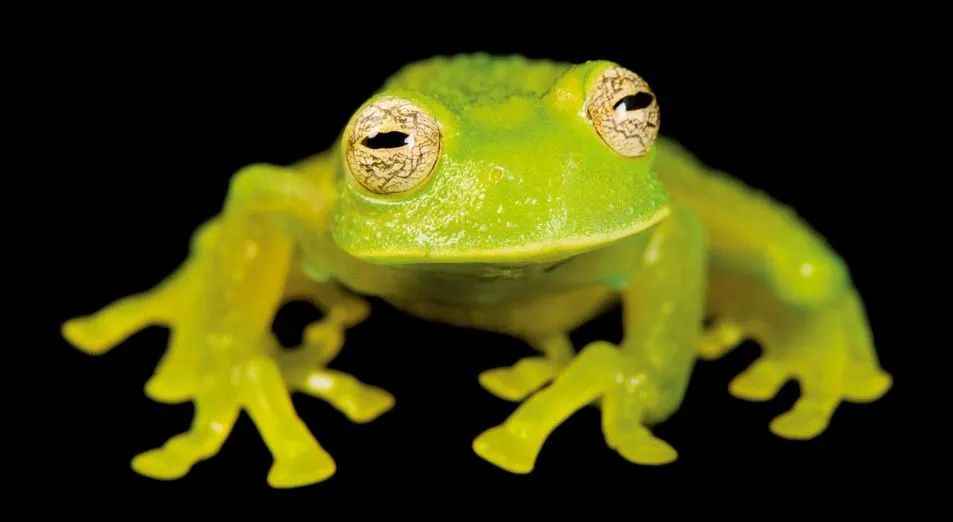
Deep in the mist-shrouded cloud forests of the Andes, a frog with a body as transparent as glass teeters on the brink of crisis. The Buckley's glass frog (Centrolene buckleyi) is renowned for its translucent abdomen, where its beating heart, digestive system, and bones are visible—a natural "living dissection." However, the International Union for Conservation of Nature (IUCN) has classified this species as Vulnerable, with wild populations collapsing due to habitat destruction and illegal trade.

The Evolutionary Enigma of Transparency
Measuring 2.5-7.5 cm in length, the frog's lack of pigmentation in its abdominal skin exposes internal organs through tissue thinner than a human hair. This "invisibility" is an evolutionary adaptation: the green dorsal surface blends with leaves, while the transparent belly minimizes shadows, making the frog nearly undetectable to predators. As ecosystem "canaries," glass frogs' survival mirrors rainforest health—they rely on high humidity and are hypersensitive to climate change and pollution.

Triple Threats: Habitat Loss, Trafficking, and Climate Change

  1. Deforestation & Agricultural Expansion
    Found in Colombia, Ecuador, and Peru, the frog's cloud forest habitat is shrinking at 1.5% annually. Logging, coffee plantations, and mining have fragmented habitats, isolating populations into "ecological islands".
  2. Illegal Pet Trade
    In 2022, Costa Rica intercepted smuggling rings targeting glass frogs alongside orchids and poison dart frogs. Live specimens, hidden in electronics or food packaging, are trafficked to Germany and the U.S., with single shipments yielding profits up to $50,000. Shanghai Customs seized a batch of Centrolene frogs in March 2025, including close relatives of C. buckleyi.
  3. Climate-Driven Droughts
    A 1.2°C temperature rise in the Andes over the past decade has reduced cloud forest humidity by 30%. Frogs now lay eggs prematurely, with tadpole mortality increasing by 60% in arid conditions.

Conservation Efforts & Scientific Breakthroughs

  • CITES Protection:All glass frog species were listed under CITES Appendix II in 2022, requiring strict trade controls.
  • IFAW's Rescue Program:The International Fund for Animal Welfare (IFAW) launched the "Andean Amphibian Corridor" in 2025, establishing 3 reserves in Ecuador. Over 200 juveniles have been successfully reintroduced.
  • Taxonomic Revision:A 2024 PeerJ study revealed that C. buckleyi is part of a species complex containing multiple unnamed lineages, two of which are now Endangered. This discovery necessitates tailored conservation strategies for each lineage.

Critical Status: From Vulnerable to the Brink

With less than 500 km² of core habitat remaining—and 80% unprotected—the IUCN warns the species could be reclassified as Critically Endangered within 20 years. "Their transparency is not just a marvel—it's a warning," says Dr. Maria Gonzalez of IBMC. "Saving these frogs means saving the rainforest's biological legacy."


Take Action:Support the Rainforest Protection Alliance's "Adopt a Tree" program or IFAW's Glass Frog Watch (www.glassfrogwatch.org) to contribute to conservation efforts.
Latest Stories
Feline News2 minute readThe Korat cat, originating from Thailand’s Nakhon Ratchasima province (formerly Korat), is a breed deeply rooted in history and cultural significance. Revered for centuries as a symbol of good luck and prosperity, these silver-blue felines have enchanted the world with their striking appearance and affectionate nature.
Feline News2 minute readThe Burmese cat, a breed steeped in history and adored for its regal charm, continues to captivate cat lovers worldwide. Originating from Myanmar (formerly Burma), these medium-sized shorthairs are celebrated for their luxurious coat, affectionate demeanor, and intelligence. Here’s an in-depth look at this ancient breed, combining the latest research and international standards
Feline News2 minute readThe Russian Blue, with its silvery-blue coat and piercing emerald eyes, stands as a paragon of feline elegance, earning the title "Noble of the Shorthairs" 5. Originating from Arkhangelsk Port in Russia—once known as the "Blue Angel Harbor"—this ancient breed derived its name not from color but from its birthplace 3. In 1860, sailors introduced them to Europe, and they debuted at London's Crystal Palace Exposition in 1875 as "Archangel Cats," captivating audiences with their otherworldly allure
Astro Information1 minute readEnceladus, Saturn’s icy moon, harbors a subsurface ocean beneath tiger-stripe fractures that erupt icy particles into space. These geysers form a dense ice cloud over the south pole, feeding Saturn’s faint E ring. The Cassini spacecraft (2004–2017) provided definitive evidence, capturing this true-color, high-resolution image during a close flyby, revealing shadowed ice chasms and active vents.
Animal Information1 minute readNative to Africa, warthogs (Phacochoerus) earn their name from the fleshy facial warts beneath their eyes. Split into the common warthog and desert warthog, these ungulates have heads comprising one-third of their body length, with tusks reaching 64 cm. They subsist on grass roots and tubers, surviving months without water—adaptations that define their harsh savanna lifestyle.
Astro Information2 minute readA close-up from NASA’s Mars Reconnaissance Orbiter (MRO) HiRISE camera unveils the weathered craters and aeolian features of southern Acidalia Planitia. While standard HiRISE imagery often appears in striking blue tones—a result of multispectral processing to enhance geological details—the region would likely appear gray or pale red to human eyes. Of course, no human has yet witnessed this Martian landscape firsthand—unless we count Andy Weir’s fictional NASA astronaut in The Martian.
Feline News1 minute readDubbed the "parlor panther," the Bombay Cat captivates with its jet-black coat and mesmerizing copper-gold eyes, an uncanny resemblance to the wild black leopard. Originating in 1958, Kentucky breeder Nikki Horner meticulously crossed sable Burmese cats with black American Shorthairs, aiming to create a domestic feline embodying both exotic allure and gentle temperament. After years of selective breeding, her vision became reality, establishing the Bombay as a breed that bridges wild aesthetics with affectionate companionship.