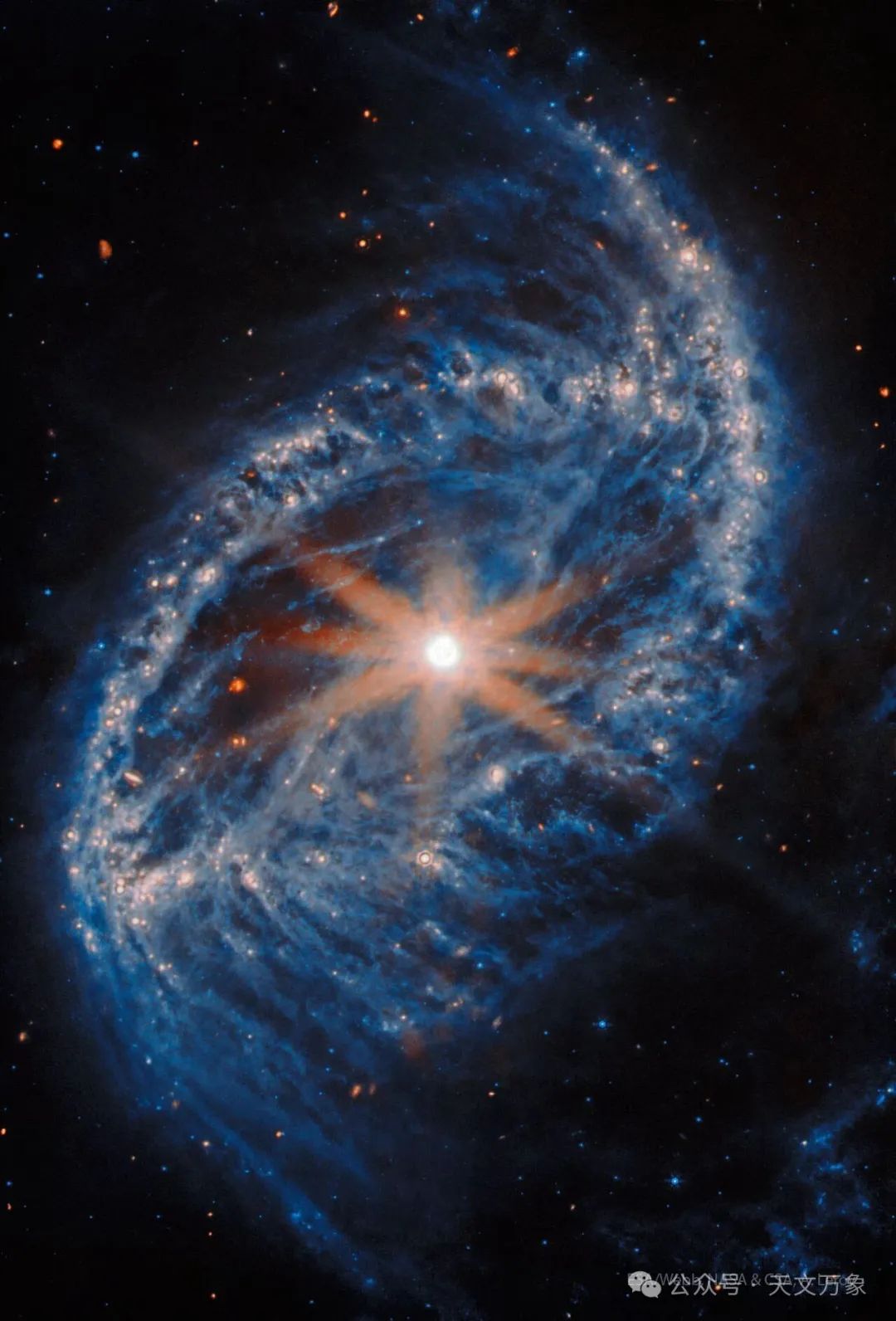
Webb’s Infrared Eye Unveils Secrets of Spiral Galaxy NGC 2566


Astro Information
Webb’s Infrared Eye Unveils Secrets of Spiral Galaxy NGC 2566

In this infrared portrait from the James Webb Space Telescope, the core of spiral galaxy NGC 2566 reveals cosmic mysteries—starting with the eight radiating spikes at its center, which aren’t astrophysical features but diffraction spikes from the telescope’s support structure. Though the bright core shows no signs of active galactic nuclei, dynamical calculations suggest a supermassive black hole of millions of solar masses lurks within, currently in a low-activity state.

Light from the Age of Dinosaurs: 76 Million Light-Years in Time

The photons reaching Earth from NGC 2566 today began their journey in the Late Cretaceous period—a cosmic voyage spanning 76 million years, concurrent with the age of dinosaurs. This proximity makes the galaxy a prime target for Hubble and Webb, which resolve its hundreds of light-year-wide turbulent gas clouds—stellar nurseries offering unprecedented insights into star formation processes.


"NGC 2566’s nearness lets us study galactic dynamics in exquisite detail," says Dr. Amina Helmi of the Leibniz Institute for Astrophysics. "Its gas clouds are so well-resolved we can track how young stars emerge from interstellar chaos."

A Barred Spiral’s Architectural Clues to Galactic Evolution

Comparable in size to the Milky Way, NGC 2566 stuns with its bright central bar and sweeping spiral arms—features that aren’t just aesthetic but key to understanding galactic evolution. The bar’s gravitational forces likely channel gas toward the core, fueling both star birth and the black hole’s growth, while the arms showcase density waves that trigger successive generations of stars.


Webb’s infrared sensitivity penetrates dust to reveal:


  • Warm Molecular Gas: Pockets of hydrogen glowing at 25–100 microns, tracing active star-forming regions.
  • Aging Stellar Populations: Redder hues from older stars in the bar, contrasting with bluer young clusters in the arms.
  • Fine Dust Filaments: Threadlike structures that map the galaxy’s magnetic fields and gas flow.


These observations are rewriting models of spiral galaxy formation, particularly how bars influence stellar dynamics over billions of years. As Webb peers deeper into NGC 2566, it’s uncovering not just a pretty face but a cosmic laboratory where the past and future of galactic evolution play out—all in light that began traveling when T. rex roamed Earth.

Latest Stories
Animal Information1 minute readScientifically known as Psychrolutes marcidus, the blobfish inhabits 600–1,200m deep-sea waters, measuring 30–38 cm in length. This gelatinous creature lacks bones and muscles, with a body density slightly lower than water—enabling it to float passively while capturing prey.
Bird Information1 minute readWith wingspans exceeding 3 meters, albatrosses reign as the Southern Ocean’s ultimate flight virtuosos, capable of continuous flights lasting weeks without touching land. Their lives are a testament to maritime endurance—spending most existence adrift over waves, they’ve even mastered the art of sleeping mid-flight.
Car Information1 minute readGatebil has solidified its status as a cornerstone of Scandinavian automotive subculture, though its exact founding date remains unchronicled. Documentation suggests organized events emerged around 2005, birthed from a grassroots movement of motorsport enthusiasts seeking a platform to showcase modified vehicles, share automotive passion, and celebrate driving joy.
Car Information1 minute readAs the E90 3 Series debuted, the E46 M3 CS emerged as the final hurrah for BMW’s iconic sports sedan. Priced at £2,400 for the Competition Package (CS Kit) in the UK, the total cost of an M3 equipped with these upgrades reached £43,555—modest upgrades on paper
Astro Information1 minute readNGC 6302, a planetary nebula nicknamed the "Butterfly Nebula," lives up to its floral-insect moniker with wing-like gas plumes spanning 3 light-years. Located 4,000 light-years away in Scorpius, this stellar corpse showcases the dramatic final act of a massive star—now a 250,000°C central star evolving into a white dwarf, its ultraviolet radiation ionizing the surrounding nebula into a kaleidoscopic display.
Car Information1 minute readAt first glance, this 2004 Lamborghini Murciélago for sale in the US appears like any other iconic V12 supercar from the Italian marque—until you catch a glimpse of its rear end. The exhaust design, far from conventional, forms a quirky silhouette that uncannily resembles a frog, complete with rounded "eyes" and a wide, downturned "mouth" framing the tailpipes.
Feline News2 minute readThe Oriental Shorthair, a breed celebrated for its striking elegance and dynamic personality, traces its origins to mid-20th century breeding programs in the UK and the US2. Developed as a close relative of the Siamese, these cats emerged from intentional crossbreeding with British Shorthairs and Abyssinians to create a feline with the Siamese’s sleek physique but expanded coat color possibilities28. By the 1970s, the breed gained international recognition, captivating cat lovers worldwide with its unique charm.