Segue 2: The 'Pitiful' Dwarf Galaxy Trapped in the Milky Way's Gravitational Grip


Astro Information
Segue 2: The 'Pitiful' Dwarf Galaxy Trapped in the Milky Way's Gravitational Grip

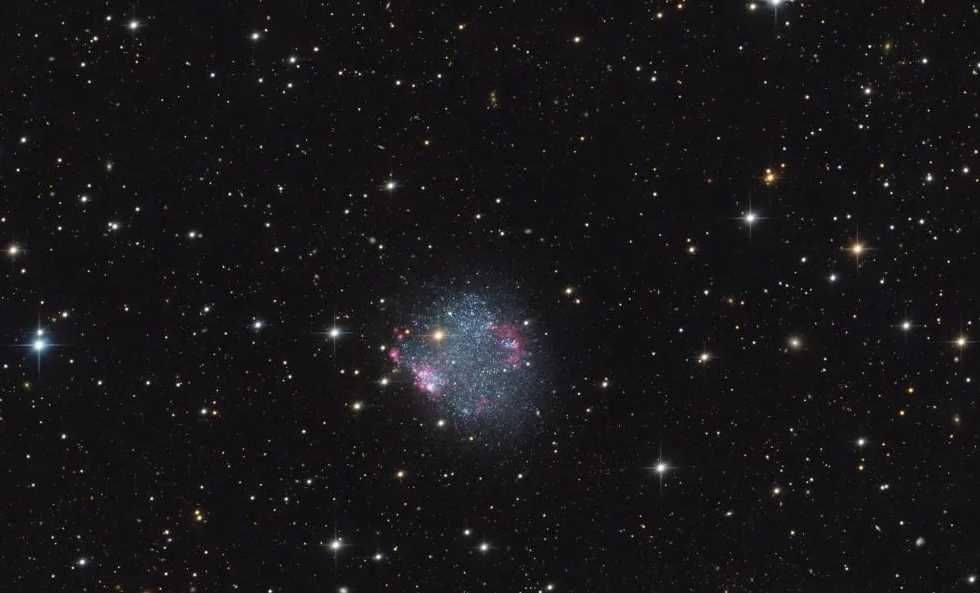
Segue 2, a diminutive galaxy spanning just 220 light-years and hosting fewer than 1,000 stars, stands in stark contrast to giants like IC 1101—making it appear as cosmic "stardust." Scientists suspect this tiny entity is an early-universe "relic," gravitationally bound to the Milky Way, forever stunted in its growth.

A Cosmic Underdog: Size and Stellar Scarcity

Measuring a mere 220 light-years across (IC 1101 spans 2 million light-years), Segue 2 is one of the smallest known dwarf galaxies. Its stellar population is meager—even a typical globular cluster in the Milky Way hosts more stars. This scarcity stems from its minimal gas reserves, which limit star formation. Observations show Segue 2’s stars are ancient, dating back to the universe’s first billion years, with little recent stellar birth.


Astronomers compare it to a "cosmic runt": its feeble gravity can’t compete with the Milky Way’s tidal forces, which strip away gas needed for star formation. This gravitational tug-of-war has locked Segue 2 in a permanent state of arrested development.

The 'Cosmic Reject' Theory: Clues to Early Galactic Evolution

Segue 2’s existence challenges models of galaxy formation. Scientists propose it may be a leftover fragment from the early universe, a "failed galaxy" that never accumulated enough mass to thrive. Its proximity to the Milky Way (300,000 light-years) suggests it was captured early in cosmic history, preventing it from merging with other dwarf galaxies to grow.


Studying Segue 2 offers insights into "cosmic underdogs": how small galaxies survive in the shadow of giants. Its high dark matter content (despite low stellar mass) also makes it a prime target for dark matter studies. As a frozen relic of the universe’s youth, Segue 2 may hold secrets to why some galaxies flourish while others, like this "pitiful" dwarf, remain eternally stunted—trapped in the gravitational embrace of their more massive neighbors.

Latest Stories
Animal Information1 minute readScientifically known as Psychrolutes marcidus, the blobfish inhabits 600–1,200m deep-sea waters, measuring 30–38 cm in length. This gelatinous creature lacks bones and muscles, with a body density slightly lower than water—enabling it to float passively while capturing prey.
Bird Information1 minute readWith wingspans exceeding 3 meters, albatrosses reign as the Southern Ocean’s ultimate flight virtuosos, capable of continuous flights lasting weeks without touching land. Their lives are a testament to maritime endurance—spending most existence adrift over waves, they’ve even mastered the art of sleeping mid-flight.
Car Information1 minute readGatebil has solidified its status as a cornerstone of Scandinavian automotive subculture, though its exact founding date remains unchronicled. Documentation suggests organized events emerged around 2005, birthed from a grassroots movement of motorsport enthusiasts seeking a platform to showcase modified vehicles, share automotive passion, and celebrate driving joy.
Car Information1 minute readAs the E90 3 Series debuted, the E46 M3 CS emerged as the final hurrah for BMW’s iconic sports sedan. Priced at £2,400 for the Competition Package (CS Kit) in the UK, the total cost of an M3 equipped with these upgrades reached £43,555—modest upgrades on paper
Astro Information1 minute readNGC 6302, a planetary nebula nicknamed the "Butterfly Nebula," lives up to its floral-insect moniker with wing-like gas plumes spanning 3 light-years. Located 4,000 light-years away in Scorpius, this stellar corpse showcases the dramatic final act of a massive star—now a 250,000°C central star evolving into a white dwarf, its ultraviolet radiation ionizing the surrounding nebula into a kaleidoscopic display.
Car Information1 minute readAt first glance, this 2004 Lamborghini Murciélago for sale in the US appears like any other iconic V12 supercar from the Italian marque—until you catch a glimpse of its rear end. The exhaust design, far from conventional, forms a quirky silhouette that uncannily resembles a frog, complete with rounded "eyes" and a wide, downturned "mouth" framing the tailpipes.
Feline News2 minute readThe Oriental Shorthair, a breed celebrated for its striking elegance and dynamic personality, traces its origins to mid-20th century breeding programs in the UK and the US2. Developed as a close relative of the Siamese, these cats emerged from intentional crossbreeding with British Shorthairs and Abyssinians to create a feline with the Siamese’s sleek physique but expanded coat color possibilities28. By the 1970s, the breed gained international recognition, captivating cat lovers worldwide with its unique charm.