Sextans A: The Cosmic Underdog Where Stars Bloom in Ambery Clusters


Astro Information
Sextans A: The Cosmic Underdog Where Stars Bloom in Ambery Clusters

While grand spiral galaxies steal the limelight with symmetric arms and glowing star nurseries, the irregular dwarf galaxy Sextans A weaves its own stellar saga in the cosmic periphery. Just 5,000 light-years across, this galaxy hosts young star clusters and star-forming regions like amber-like clumps suspended in space, blooming 4.5 million light-years away in the constellation Sextans. As a sentinel on the Local Group’s fringe, it stands distant from the galactic family including the Andromeda Galaxy and the Milky Way.

A Dwarf Galaxy’s Quiet Stellar Renaissance

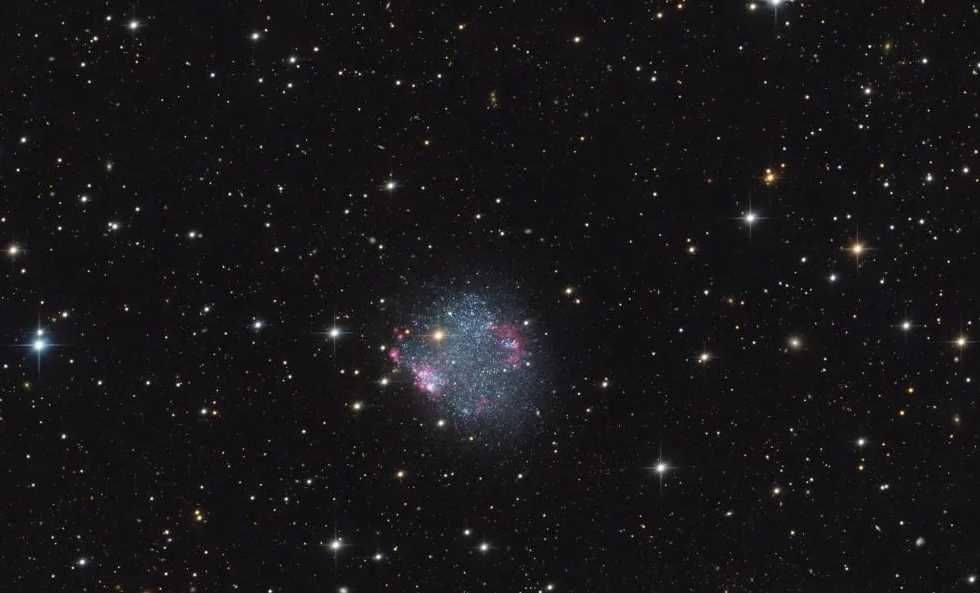
Sextans A defies the spiral galaxy’s grand design with the chaotic beauty of the universe’s underdogs. Its star-forming regions glow in pink hydrogen nebulae, punctuated by blue clusters of newborn stars—each "droplet" of stellar birth containing millions of suns. The galaxy’s irregular shape, sculpted by gravitational interactions with neighboring systems, belies its role as a prolific star factory despite its diminutive size.


"Astronomers once overlooked dwarf galaxies like Sextans A, but they’re crucial for understanding star formation in low-mass environments," says Dr. Maya Johnson of the Lowell Observatory. The galaxy’s gas-rich composition—largely hydrogen and helium with little heavy elements—makes it a time capsule for studying primordial star birth.

A Fringe Dweller Framed by Milky Way Stars

This telescope image reveals Sextans A veiled by golden star trails from foreground Milky Way stars, creating a cosmic illusion of lace draped over the distant galaxy. The contrast between the nearby stars’ sharp spikes and Sextans A’s diffuse glow highlights the vastness of intergalactic space:


  • Foreground Stars: These belong to our galaxy, lying just thousands of light-years away, their light passing through the same line of sight.
  • Sextans A’s Clusters: Each amber-hued clump is a star-forming region tens to hundreds of light-years across, where massive stars ionize surrounding gas.


At the Local Group’s edge, Sextans A survives in relative isolation, a rare example of a galaxy evolving without frequent major mergers. Its stars, born in bursts over billions of years, carry chemical signatures that trace the galaxy’s history—a cosmic story written in the glow of its ambery stellar nurseries, far from the bustling cores of larger galactic neighbors.

Latest Stories
Animal Information1 minute readScientifically known as Psychrolutes marcidus, the blobfish inhabits 600–1,200m deep-sea waters, measuring 30–38 cm in length. This gelatinous creature lacks bones and muscles, with a body density slightly lower than water—enabling it to float passively while capturing prey.
Bird Information1 minute readWith wingspans exceeding 3 meters, albatrosses reign as the Southern Ocean’s ultimate flight virtuosos, capable of continuous flights lasting weeks without touching land. Their lives are a testament to maritime endurance—spending most existence adrift over waves, they’ve even mastered the art of sleeping mid-flight.
Car Information1 minute readGatebil has solidified its status as a cornerstone of Scandinavian automotive subculture, though its exact founding date remains unchronicled. Documentation suggests organized events emerged around 2005, birthed from a grassroots movement of motorsport enthusiasts seeking a platform to showcase modified vehicles, share automotive passion, and celebrate driving joy.
Car Information1 minute readAs the E90 3 Series debuted, the E46 M3 CS emerged as the final hurrah for BMW’s iconic sports sedan. Priced at £2,400 for the Competition Package (CS Kit) in the UK, the total cost of an M3 equipped with these upgrades reached £43,555—modest upgrades on paper
Astro Information1 minute readNGC 6302, a planetary nebula nicknamed the "Butterfly Nebula," lives up to its floral-insect moniker with wing-like gas plumes spanning 3 light-years. Located 4,000 light-years away in Scorpius, this stellar corpse showcases the dramatic final act of a massive star—now a 250,000°C central star evolving into a white dwarf, its ultraviolet radiation ionizing the surrounding nebula into a kaleidoscopic display.
Car Information1 minute readAt first glance, this 2004 Lamborghini Murciélago for sale in the US appears like any other iconic V12 supercar from the Italian marque—until you catch a glimpse of its rear end. The exhaust design, far from conventional, forms a quirky silhouette that uncannily resembles a frog, complete with rounded "eyes" and a wide, downturned "mouth" framing the tailpipes.
Feline News2 minute readThe Oriental Shorthair, a breed celebrated for its striking elegance and dynamic personality, traces its origins to mid-20th century breeding programs in the UK and the US2. Developed as a close relative of the Siamese, these cats emerged from intentional crossbreeding with British Shorthairs and Abyssinians to create a feline with the Siamese’s sleek physique but expanded coat color possibilities28. By the 1970s, the breed gained international recognition, captivating cat lovers worldwide with its unique charm.